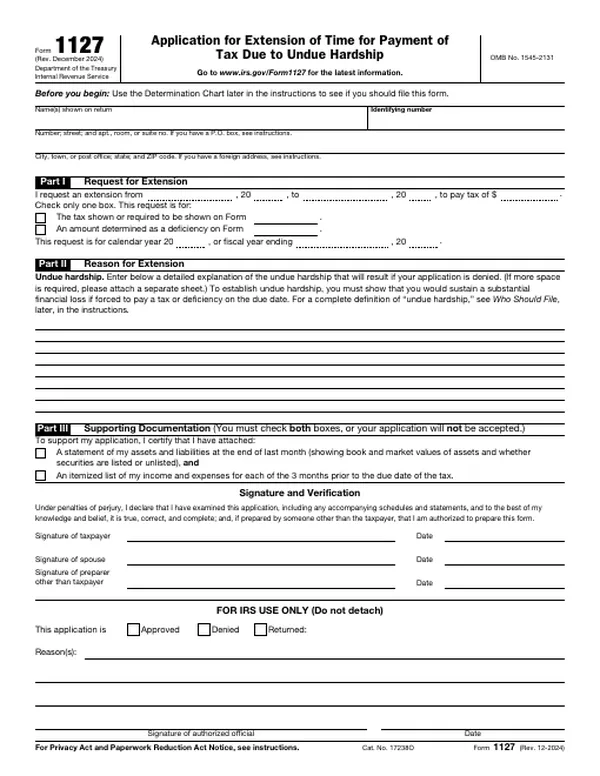
When to use Form 1127, and when another form is right
IRC 6161 lets the IRS extend the time to pay tax shown on a return for up to 6 months (longer for a taxpayer abroad) and a deficiency for up to 18 months, with up to 12 more in exceptional cases. No extension is available for a deficiency due to negligence, intentional disregard of rules or fraud (IRC 6161(b)(3)). The form lists the taxes covered, including income and self-employment taxes, withholding on nonresident aliens and foreign corporations, private foundation and exempt organization taxes, gift taxes, and several other excise taxes.
The standard is narrow. IRM 5.1.12.26, following Treas. Reg. 1.6161-1(b), says undue hardship means more than inconvenience: substantial financial loss, such as selling property at a sacrifice price, must result from paying on time. “The extension will not be granted upon a general statement of hardship.” And “If a market exists, the sale of property at the current market price is not ordinarily considered as resulting in an undue hardship.”
The form's determination chart sends other requests elsewhere:
- More time to file an income tax return: Form 4868 or 2350. The IRM is blunt: “For example, Form 1127 may not be used to request an extension of time to file a return.”
- Estate tax: Form 4768.
- Monthly payments, including streamlined or partial payment agreements: Form 9465 or the Online Payment Agreement. See installment agreements.
- Anything else: contact the IRS and see Pub. 594.
Form 1127 is mostly useful when the client has an asset that can be sold for full value within months but would bring a fire-sale price now, and the client wants to avoid the failure-to-pay penalty rather than spread payments over years.
Line by line
- HeaderIdentifying number, name(s), address
- Individuals enter the SSN or ITIN; for a joint return or joint deficiency, both names in return order and the first-listed spouse's number. Businesses enter the name and EIN.
- Part IRequest for Extension
- The printed line reads I request an extension from (date) to (date) to pay tax of $ (amount). The from date is the return due date without extensions, or the payment due date on the bill. The proposed date can be up to 6 months out for tax on a return (more if out of the country) or 18 months for a deficiency (12 more in exceptional cases). Check one box: tax shown or required to be shown on Form [number], or an amount determined as a deficiency on Form [number]. Enter the calendar year or fiscal year end.
- Part IIReason for Extension
- A detailed explanation of the undue hardship if the application is denied: what asset would be sold, why the price would be a sacrifice, when full value can be realized. A general statement is not enough.
- Part IIISupporting Documentation
- Check both boxes, or the application will not be accepted: a statement of assets and liabilities at the end of last month (book and market values, and whether securities are listed), and an itemized list of income and expenses for each of the 3 months before the tax's due date.
- SignatureSignature and Verification
- Under penalties of perjury, by the taxpayer, both spouses for a joint liability, or a preparer authorized to prepare it.
- IRS useApproved / Denied / Returned
- Completed by the IRS official with the reason.
Where and how to file
File with the IRS, Attn: Advisory Group Manager, for the area of the taxpayer's legal residence or principal place of business; Pub. 4235 lists the offices. Gift tax applications (Form 709 or 709-NA) go to Department of the Treasury, Internal Revenue Service, Stop 824G, 7940 Kentucky Drive, Florence, KY 41042-2915.
Timing is the main trap. The form says to file as soon as the liability is known, and: for tax on an upcoming return, Form 1127 must be received on or before the return due date, not including extensions; for a deficiency, on or before the payment due date in the bill. IRM 5.1.12.26.2 tells Advisory to use the postmark to judge timeliness and to return late applications as nonprocessable. An application received in the wrong office is forwarded.
What the IRS does with it
Collection Advisory first checks whether the application is processable (IRM 5.1.12.26.2). It must clearly be an IRC 6161 hardship request, be timely, and include: name, address and TIN; whether it is for return tax or a deficiency; the due date; the proposed extension date; the amount; the form number and year; an explanation of the hardship; the asset and liability statement; the 3 months of income and expenses; and a signature under penalties of perjury. If anything is missing, the form is returned with the “Returned” box checked and the reasons, by letter from the Advisory group manager.
A processable application is reviewed for undue hardship. Treas. Reg. 1.6161-1(c), quoted in IRM 5.1.12.26.1, says applications will be examined and, “within 30 days, if possible, will be denied, granted, or tentatively granted subject to certain conditions”. Approval is recommended in writing and goes to the Advisory territory manager; a denial needs the group manager's concurrence and a letter explaining why (IRM 5.1.12.26.3).
When an extension is approved, Advisory requests a TC 470 to hold the account in status 47 and a TC 270 for $0.00 to stop the failure-to-pay penalty, and monitors the case (IRM 5.1.12.26.4). The IRM states: “Approval of the extension does not relieve the taxpayer from liability for interest that accrues during the period of the extension, but does provide relief from the failure to pay (FTP) tax penalty to the extended due date, even if the taxpayer fails to submit full payment by that date.” After the extended date the penalty starts again, computed manually. The form adds: “You must pay the tax before the extension runs out.” Do not wait for a bill.
Common rejections and mistakes
- Filing after the return due date (an extension to file does not extend this deadline) or after the bill's due date.
- Using Form 1127 as an extension to file.
- A general hardship statement with no specific asset or loss.
- Missing either attachment, or not checking both Part III boxes.
- Asking for more than 6 months on return tax without being abroad.
- A deficiency from negligence or fraud, which is not eligible.
- Sending it to a service center instead of the Advisory group (or Florence for gift tax).
- Assuming interest stops. It does not; only the failure-to-pay penalty is relieved.
Questions practitioners ask
Does Form 1127 stop interest?
No. IRM 5.1.12.26.4 says an approved extension does not relieve interest that accrues during the extension. It relieves the failure-to-pay penalty through the extended due date.
Can Form 1127 be filed after an extension to file was obtained?
For tax on a return, it must be received by the return's due date not including extensions. An extension to file does not extend the Form 1127 deadline.
What counts as undue hardship?
More than inconvenience: a substantial financial loss, such as selling property at a sacrifice price, if the tax is paid on time. Selling at market price where a market exists is ordinarily not undue hardship.
How long can the extension be?
Up to 6 months for tax shown on a return (longer if the taxpayer is abroad, except for certain excise taxes), and up to 18 months for a deficiency, with up to 12 more months in exceptional circumstances.
Where is Form 1127 filed?
With the Collection Advisory group manager for the taxpayer's area (see Pub. 4235), or with the Florence, Kentucky gift tax unit for Form 709 and 709-NA liabilities.
What happens if the application is incomplete?
It is returned as nonprocessable with the reasons checked. If the deadline has passed by then, a new application will also be late.