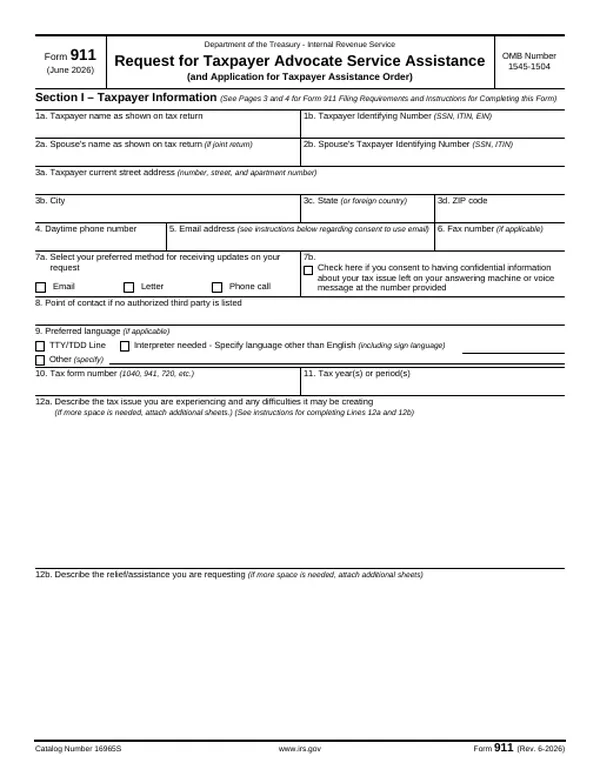
When to use Form 911, and when another route is right
TAS is an independent office within the IRS. It accepts cases under nine criteria set by the National Taxpayer Advocate under IRC 7803(c), grouped in IRM 13.1.7.3:
| Group | Criteria |
|---|---|
| Economic burden | 1: the taxpayer is experiencing or about to suffer economic harm. 2: an immediate threat of adverse action (levy, lien, seizure, eviction, utility cutoff). 3: significant costs if relief is not granted, including professional fees. 4: irreparable injury or long-term adverse impact. |
| Systemic burden | 5: a delay of more than 30 days to resolve a tax account problem. 6: no response or resolution by the date promised. 7: a system or procedure failed to operate as intended or failed to resolve the problem. |
| Best interest of the taxpayer | 8: the way the law is being administered raises equity concerns or impairs taxpayer rights. |
| Public policy | 9: the National Taxpayer Advocate designates the issue by memo. |
Two points from the IRM help practitioners. First, “Taxpayers do not need to validate their hardship to be accepted into the TAS program.” Second, Criteria 7 is a catchall: “When a taxpayer specifically requests TAS assistance and no other case criteria is met, accept the case under Case Criteria 7.” Criteria 5 measures the 30 days from the normal processing time for the action where one exists, or from the first request for help where none exists, and delays caused by the taxpayer not responding do not count.
IRM 13.1.7.4 lists what TAS will not take: inquiries that only challenge the constitutionality of the tax system, frivolous positions, and, for systemic-burden cases (criteria 5 to 7), single-issue delays in processing original or amended returns, unpostables, injured spouse claims and identity theft issues, unless a congressional office refers the case or the delay is holding up an open exam or collection matter. TAS will also decline certain current year refund holds by the Return Integrity Verification Operations filters during set windows.
Other routes may fit better. A levy or lien dispute can go to Form 9423 (CAP) or, after a CDP notice, Form 12153. An exam disagreement goes to Appeals. A penalty goes through the abatement process. TAS works alongside those, not instead of them; IRM 5.1.9.4.1 tells Collection to refer cases meeting TAS criteria that it cannot resolve within 24 hours using Form 911. For a practitioner, the Practitioner Priority Service line is the first stop for account problems.
Line by line
- 1a-1bTaxpayer name and TIN
- Name as shown on the return and the SSN, ITIN or EIN.
- 2a-2bSpouse's name and TIN
- Only if the request relates to a joint return.
- 3a-3d, 4Current address and daytime phone
- The taxpayer's current mailing address and phone with area code.
- 5-6Email address and fax
- Entering an email address is consent to send and receive encrypted email with TAS. Leave line 5 blank to avoid email.
- 7a-7bPreferred update method and voicemail consent
- Email, letter or phone call. Line 7b consents to confidential information being left on voicemail; leave it unchecked if others hear the messages.
- 8Point of contact if no authorized third party is listed
- For an entity, the individual authorized to act for it. For an individual, TAS needs a Form 2848 or 8821 before it can share information with anyone else, except a joint filer spouse.
- 9Preferred language
- Interpreter, TTY/TDD or other needs.
- 10-11Tax form number and tax years or periods
- For example Form 1040 and the calendar year, or Form 941 and the quarter.
- 12aDescribe the tax issue
- The problem, the hardship it is causing, and what the IRS has or has not done. If the issue is an IRS delay of more than 30 days, give the date of the first contact. Tie the facts to a criterion: a levy date, an eviction notice, a promised date that passed.
- 12bDescribe the relief requested
- The specific action needed (release a levy, issue a manual refund, post a payment) and supporting documents.
- 13-14Taxpayer and spouse signatures
- Both spouses sign a joint request; one signs if only one wants help. A business request is signed by an authorized officer with title. The page also contains a consent to TAS contacting third parties without the IRC 7602(c) notice.
- Section II AForm 2848, Power of Attorney
- The representative's name, CAF number, address, phone, fax, signature and date. Attach the Form 2848. The instructions state: “The taxpayer does not need to sign the Form 911 if it is being submitted by an authorized representative.”
- Section II BForm 8821
- Same fields for a designee. The form reminds filers that an 8821 designee cannot advocate or represent; TAS uses this section for case creation.
Where and how to file
| Method | From the June 2026 form |
|---|---|
| tas.form.911.request.for.assistance@irs.gov (not encrypted; sending is consent to email) | |
| Fax | (855) 828-2723; from overseas 1 (304) 707-9793 |
| 7940 Kentucky Dr, MS 11 G, Florence, KY 41042 |
Attach documents with the form; the instructions say they can speed resolution. If there is no response within 30 days, email the same address with “No Response” in the subject line. Do not send a second Form 911 for the same issue. The National Taxpayer Advocate toll-free line is 877-777-4778 (shown on Form 9423).
What TAS does with it
A case advocate reviews acceptance, sets an action plan and contacts the taxpayer or representative. IRM 13.1.18.4 sets maximum time frames: TAS must take the next action within five workdays of the last one if no follow-up date was set, and give the taxpayer a next contact date. For complex cases, contacts must be scheduled at least every 30 calendar days unless the taxpayer or representative agrees otherwise.
On collection, IRM 13.1.10.11 states there is no legal requirement to stop, but “it is the IRS's policy to suspend certain collection actions” such as liens, levies and seizures while the TAS case is open. TAS can place holds directly on accounts within its authority; for accounts assigned to a revenue officer or open in ACS, it requests the hold from that function. If the function refuses, the case advocate discusses a Taxpayer Assistance Order with the manager.
TAS works through the operating divisions with Operations Assistance Requests. It cannot decide the merits of a liability on the IRS's behalf, and the TAO is the formal tool when the IRS will not act.
The form warns that filing “does not suspend any applicable periods for you to perform acts related to assessment or collection”. A Tax Court petition, a CDP request and a refund claim all keep their own clocks. Use the CDP deadline calculator and the statute date calculator alongside a TAS request.
Common mistakes
- Treating TAS as a substitute for a deadline. File the petition or hearing request regardless.
- Vague line 12a. State the criterion facts with dates and attach the levy notice, eviction notice or the IRS letter promising action.
- No authorization attached. Without a Form 2848 or 8821 copy, TAS cannot talk to the representative about an individual's case.
- Sending duplicates by email, fax and mail, or a second Form 911 for the same issue.
- Using Form 911 for a plain processing delay of an original or amended return with no other harm. IRM 13.1.7.4 generally excludes those from systemic-burden acceptance.
- Frivolous arguments, which the form says can draw a $5,000 penalty.
Questions practitioners ask
Does the client have to sign Form 911 if I submit it?
No. The instructions say the taxpayer does not need to sign when an authorized representative submits the form and signs Section II. Attach the Form 2848 or 8821.
Will TAS stop a levy?
IRS policy under IRM 13.1.10.11 is to suspend certain collection actions while a TAS case is open, though there is no legal requirement. TAS requests holds from the function that controls the account, and can pursue a Taxpayer Assistance Order if the function refuses.
Does filing Form 911 extend the Tax Court or CDP deadline?
No. The form states that it does not suspend any period for acts related to assessment or collection, including petitioning the Tax Court or requesting a CDP hearing.
What counts as a 30-day delay for Criteria 5?
Under IRM 13.1.7.3.2, more than 30 days beyond the normal processing time where one is published, or more than 30 days after the first request for help where none is published. Delays caused by the taxpayer not responding do not qualify.
Can TAS help with a delayed amended return?
Generally not as a stand-alone systemic delay. IRM 13.1.7.4 excludes amended return processing from systemic-burden acceptance unless there is economic burden, a congressional referral, or an open exam or collection issue the return would resolve.
How do I follow up if TAS has not responded?
After 30 days, email the Form 911 address with No Response in the subject line, as the form instructs, rather than submitting a new Form 911.