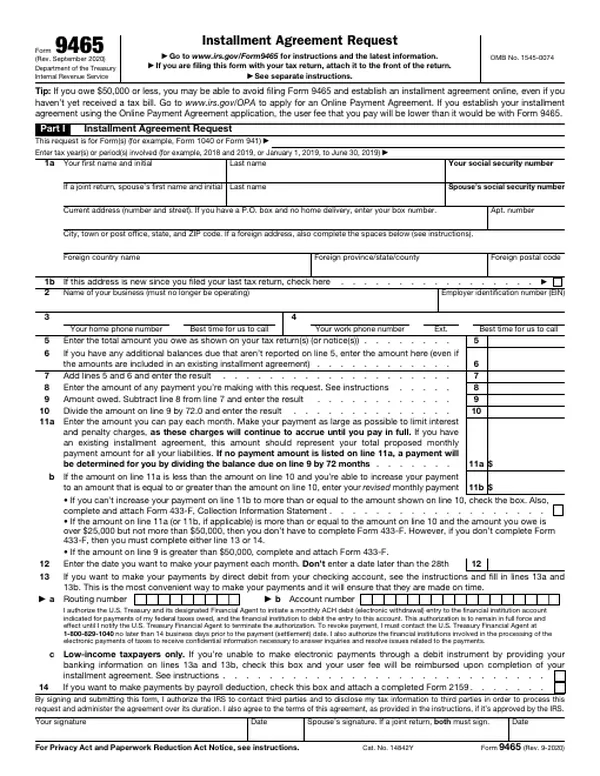
When to use Form 9465, and when another route is right
The July 2024 instructions limit the form to individuals who owe income tax on Form 1040 or 1040-SR, who are or may be responsible for a trust fund recovery penalty, who owe employment taxes from a sole proprietorship that is no longer operating, or who owe an individual shared responsibility payment. They say not to use it if:
- The balance can be paid within 180 days. Call 800-829-1040, or for balances of $100,000 or less use the short-term plan in the Online Payment Agreement (OPA) application. No user fee applies.
- The taxpayer wants to apply online. OPA is available for balances of $50,000 or less and carries a lower fee.
- The business is still operating and owes employment or unemployment taxes. Call the number on the latest notice instead.
- The taxpayer is in bankruptcy or has a pending or accepted offer in compromise.
The instructions describe three agreement types. A guaranteed agreement applies when the tax owed is $10,000 or less and the taxpayer has filed and paid for the past 5 years, has had no installment agreement for income tax, will pay within 3 years and cannot pay in full now. A streamlined agreement covers assessed liabilities up to $25,000 (individuals, in-business income tax only, out-of-business taxpayers) or $25,001 to $50,000 for individuals and out-of-business sole proprietors who pay by direct debit or payroll deduction, paid within 72 months or by the CSED. Anything that will not full pay by the CSED is a partial payment installment agreement, which requires financial disclosure and periodic review.
The IRM has moved on from that vocabulary for revenue officer cases. IRM 5.14.5.2 (07-21-2026) now uses a “Simple Payment Plan” for IMF, out-of-business sole proprietor and BMF non-trust accounts with an aggregate unpaid balance of assessment of $50,000 or less, paid in full by the CSED, with no direct debit requirement and no managerial approval; “A Collection Information Statement (CIS) is not required when the account meets the criteria for a Simple Payment Plan.” The Form 9465 instructions have not been revised to match. See installment agreements and streamlined agreements.
Line by line
- HeaderForm(s) and tax year(s) or period(s)
- The return types (Form 1040, Form 941) and every period to be covered.
- 1a-1bName, SSN, spouse, address
- For a joint return, names and SSNs in the same order as on the return. Check 1b if the address is new since the last return.
- 2Name of your business (must no longer be operating) and EIN
- Only for out-of-business sole proprietor liabilities.
- 3-4Home and work phone, best time to call
- 5Total amount you owe
- From the returns or notices, which can cover more than one year.
- 6Additional balances due not reported on line 5
- Include balances already in an existing agreement and any other adjustments.
- 7Add lines 5 and 6
- 8Payment you are making with this request
- Pay as much as possible to cut interest and penalties. If filing alone, pay to “United States Treasury” with name, TIN, phone and the year and form.
- 9Amount owed
- Line 7 minus line 8. This figure drives the $25,000 and $50,000 tests.
- 10Line 9 divided by 72.0
- The 72-month benchmark payment.
- 11aAmount you can pay each month
- If there is an existing agreement, enter the total proposed payment for all liabilities. If blank, the IRS divides line 9 by 72. A payment that will not full pay by the CSED may be considered for a PPIA.
- 11bRevised monthly payment
- If 11a is below line 10 and the taxpayer can raise it to line 10 or more, enter it here. If not, check the box and attach Form 433-F. If line 9 is over $25,000 but not over $50,000 and the payment meets line 10, either attach Form 433-F or complete line 13 or 14.
- 12Payment day
- Any day from the 1st to the 28th.
- 13a-13bDirect debit routing and account numbers
- Nine-digit routing number and up to 17-character account number. The direct debit is not approved unless the taxpayer (and spouse) signs.
- 13cLow-income taxpayers only
- Check if unable to pay by direct debit; the user fee is reimbursed on completion.
- 14Payroll deduction
- Check and attach Form 2159, signed by the employer.
- SignatureTaxpayer and spouse
- Both sign a joint request. Signing authorizes third-party contacts and accepts the agreement terms.
- Part IIAdditional information (lines 15 to 33)
- Only if all three apply: a default in the past 12 months, a balance over $25,000 but not over $50,000, and a payment below line 10. Covers county, household size, pay frequency, net pay, vehicles, health insurance, court-ordered payments and similar. Lines 21 and 22 cover a spouse's income if the taxpayer lives with and shares expenses with the spouse, or lives in a community property state.
User fees
The fees in the July 2024 instructions are $22 for an OPA direct debit agreement, $107 for a direct debit agreement set up any other way, $69 for an OPA agreement paid by check or card, and $178 otherwise, including payroll deduction. Modifying an agreement generally costs $89 ($43 for low-income taxpayers), or $10 to reinstate or restructure through OPA.
IRM 5.14.1.2 (07-20-2026) shows updated rates for agreements entered into on or after July 5, 2026: the OPA direct debit origination fee is $29, and the OPA low-income reinstatement or restructuring fee is $6. The manual direct debit ($107), manual regular ($178), OPA regular ($69) and general reinstatement ($89) fees are unchanged. Low-income taxpayers (AGI at or below 250 percent of the federal poverty guidelines) pay $43, which is waived for a direct debit agreement and reimbursed on completion otherwise; Form 13844 requests that status. The IRM also notes the fee is due with the first payment.
Where and how to file
If filing with the return, attach Form 9465 to the front. If the return is already filed or the request answers a notice, mail the form alone to the service center in the instructions. There are separate charts for returns with Schedule C, E or F and for those without; a sample:
| Taxpayer | Address |
|---|---|
| No Schedule C, E or F: AL, FL, GA, KY, LA, MS, NC, SC, TX, VA | Department of the Treasury, Internal Revenue Service, P.O. Box 47421, Stop 74, Doraville, GA 30362 |
| No Schedule C, E or F: AK, AZ, CO, CT, DE, DC, HI, ID, IL, ME, MD, MA, MT, NV, NH, NJ, NM, ND, OR, RI, SD, TN, UT, VT, WA, WI, WY | Department of the Treasury, Internal Revenue Service, 310 Lowell St., Stop 830, Andover, MA 01810 |
| No Schedule C, E or F: AR, CA, IN, IA, KS, MI, MN, MO, NE, NY, OH, OK, PA, WV | Department of the Treasury, Internal Revenue Service, Stop P-4 5000, Kansas City, MO 64999-0250 |
| With Schedule C, E or F: AL, AR, GA, IL, IN, IA, KS, KY, LA, MI, MN, MS, MO, NE, NJ, ND, OH, OK, PA, SD, TN, TX, WV, WI | Department of the Treasury, Internal Revenue Service, P.O. Box 69, Stop 811, Memphis, TN 38101-0069 |
| Foreign address, territory, APO/FPO, Form 2555 or 4563 filers, dual-status aliens | Department of the Treasury, Internal Revenue Service, 3651 South I-H 35, 5501AUSC, Austin, TX 78741 |
Check the full charts in the instructions for other states. For an account assigned to a revenue officer, the IRM notes OPA cannot be used; work the agreement through the RO. The installment agreement eligibility calculator runs the tier tests.
What the IRS does with it
The instructions say: “We will usually let you know within 30 days after we receive your request whether it is approved or denied.” Requests for returns filed after March 31 may take longer.
Under IRM 5.14.1.3 a request becomes pending (TC 971 AC 043) only when the taxpayer is identified, the liability is identified, a specific payment is proposed, filing requirements are met and a required CIS is provided. “A specific monthly payment amount must be specified for the account to be marked” pending. The pending code matters: “These transaction codes prevent enforcement (levy) action for the duration of the pending status.” A request is not pending if returns are missing, if the taxpayer is pursuing another resolution such as an offer, or if it was made solely to delay collection.
Approval requires filing compliance. The instructions state: “Your request for an installment agreement will be denied if any required tax returns haven't been filed.” The IRM says no agreement may be approved until current estimated tax or deposit compliance is achieved, though the request can be pending before then.
Other effects listed in IRM 5.14.1.2: refunds continue to offset; payments go to tax, then penalty, then interest; the failure-to-pay penalty drops from 0.5 to 0.25 percent per month for individuals who filed on time, if no CP 504, LT11 or Letter 1058 was sent; and “The CSED will be suspended while the IA is pending, for 30 days following the rejection or termination of an IA, and for the period that Appeals is considering the rejection or termination of an IA.” A lien is generally not filed on guaranteed or streamlined agreements, per the instructions. A rejection or proposed termination can be appealed within 30 days through CAP on Form 9423 (IRM 5.1.9.4.2).
Common rejections and mistakes
- Unfiled returns. The request is denied and is not even pending.
- No payment amount on line 11a, so the request is not pending and levy protection does not start.
- Missing Form 433-F when line 9 exceeds $50,000 or the payment is below line 10.
- $25,001 to $50,000 with no direct debit, payroll deduction or Form 433-F.
- Using Form 9465 for an operating business's payroll tax. Call instead.
- Payment date after the 28th.
- Unsigned direct debit section, or a joint request without the spouse's signature.
- Not adjusting withholding or estimates, which leads to a new balance and default.
Questions practitioners ask
Is Form 9465 needed if my client owes less than $50,000?
Usually not. The instructions say a taxpayer who owes $50,000 or less can apply online through OPA, often without Form 9465, and pays a lower user fee.
When is Form 433-F required with Form 9465?
When line 9 is more than $50,000, when the proposed payment is below line 10 and cannot be raised, or when the balance is between $25,000 and $50,000 and the taxpayer will not pay by direct debit or payroll deduction.
Can the IRS levy while the request is pending?
Generally no. IRM 5.14.1.3 says the pending code prevents levy for the duration of the pending status, and the instructions note the IRS is generally prohibited from levying while a request is pending, with certain exceptions.
What are the user fees now?
The July 2024 instructions list $22 OPA direct debit, $107 other direct debit, $69 OPA regular and $178 other. IRM 5.14.1.2 raises the OPA direct debit fee to $29 for agreements entered into on or after July 5, 2026; low-income fees are $43, waived or reimbursed under conditions.
Can an operating business use Form 9465 for payroll taxes?
No. The instructions say a business still operating that owes employment or unemployment taxes should call the number on its latest notice.
What if the IRS rejects the request?
The taxpayer has 30 days from the rejection letter to appeal through the Collection Appeals Program on Form 9423, and levy is barred during that period and during a timely appeal.