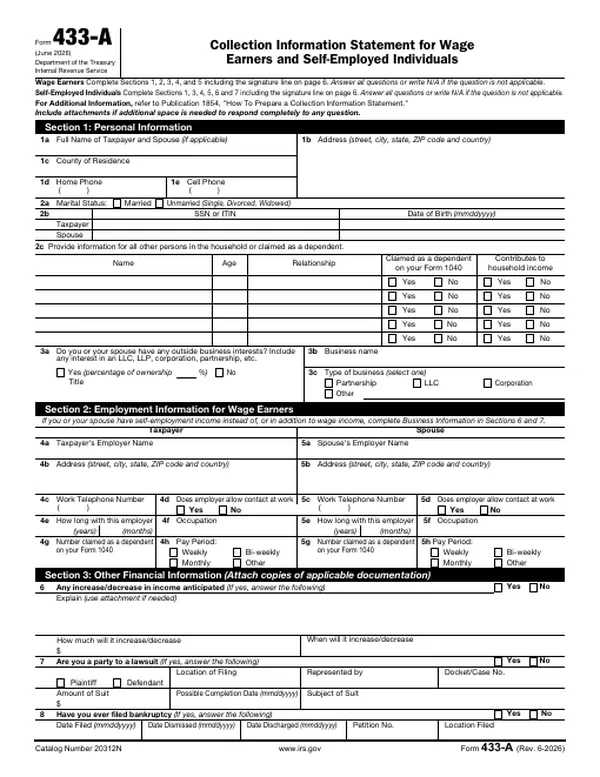
When to use Form 433-A (and when another form is right)
Form 433-A is the long-form collection information statement (CIS) for individuals. IRM 5.15.1.2 tells revenue officers to “Secure a complete Collection Information Statement if the taxpayer is unable to full pay and does not qualify for a Guaranteed Installment Agreement, Simple Payment Plan, or Simple Payment Plan (Business Trust Fund).” In practice it arrives as a request from a revenue officer after a balance has been assigned to Field Collection (see when a revenue officer is assigned), or it is prepared to support a currently not collectible request or a non-streamlined installment agreement.
Three other forms overlap with it, and choosing the wrong one costs time:
| Situation | Form | Why |
|---|---|---|
| Account in ACS or a campus, individual | Form 433-F | IRM 5.15.1.2 describes 433-F as the statement used by the Automated Collection System and the campuses for individuals |
| Revenue officer case, IMF balance under $250,000 or wage-earner TFRP under $100,000 | Form 433-F may be accepted | IRM 5.15.1.2 lets revenue officers use 433-F in those two situations |
| Offer in compromise | Form 433-A (OIC), Rev. April 2026, inside the Form 656-B booklet | IRM 5.15.1.2: “Form 433-F cannot be used for Offer-in-Compromise cases or for cases designated as Abusive Tax Avoidance Transactions (ATAT).” The OIC version computes the minimum offer |
| Business entity (corporation, partnership, multi-member LLC) | Form 433-B | 433-A is for individuals; Section 6, line 52 sends anyone who is not a sole proprietor to 433-B |
| Guaranteed IA or Simple Payment Plan | Usually none | IRM 5.14.1.4: “If the taxpayer is eligible for a Simple Payment Plan, Guaranteed Installment Agreement or Simple Payment Plan (Business Trust Fund), financial statements are not required.” |
Partnerships and single-member LLCs where the individual owner is the liable taxpayer need both forms: IRM 5.15.1.2 says those cases require analysis of the business figures on Form 433-B and the owner's living expenses on Form 433-A. For the comparison of all three statements, see collection information statements: Forms 433-A, 433-B and 433-F.
Section by section
The top of page 1 states who completes what: wage earners complete Sections 1, 2, 3, 4 and 5, self-employed individuals complete Sections 1, 3, 4, 5, 6 and 7, and both sign on page 6. The form tells filers to “Answer all questions or write N/A if the question is not applicable.” Line numbers below are from the June 2026 revision.
- Sec. 1Personal Information (lines 1a to 3c)
- Names, address, county of residence, phones, marital status, SSN or ITIN and date of birth for the taxpayer and spouse, every other household member (age, relationship, whether claimed as a dependent and whether they contribute to household income), and any outside business interest including an LLC, LLP, corporation or partnership, with ownership percentage and title.
- Sec. 2Employment Information for Wage Earners (lines 4a to 5h)
- Employer name and address, whether the employer allows contact at work, time with the employer, occupation, dependents claimed and pay period for the taxpayer and spouse. The form directs anyone with self-employment income to Sections 6 and 7 as well.
- Sec. 3Other Financial Information (lines 6 to 11)
- Yes or no questions with follow-up detail: anticipated income changes (6), lawsuits (7), bankruptcy (8), U.S. passport (8a), living outside the U.S. for six months or longer in the past 10 years (8b), dual citizenship (8c), incarceration (9a), interests as a trust, estate or life insurance beneficiary (9b), trustee or fiduciary roles (9c), safe deposit boxes (10), and transfers in the past 10 years of assets worth more than $10,000 (11). Attach documentation the section asks for.
- Sec. 4Personal Asset Information (lines 12 to 20)
- Cash on hand (12); personal bank accounts including online and mobile accounts such as PayPal and stored value cards (13, total on 13e); investments including retirement accounts and any business entity in which the taxpayer has a financial interest (14); digital assets, with the names of everyone who has access to private keys or wallets (15, total on 15e); available credit (16e); cash value life insurance less loans (17); real property (18); vehicles including boats, RVs and trailers (19); and personal assets including intangibles such as licenses, domain names and patents (20). Foreign assets are included.
- Sec. 5Monthly Income and Expenses (lines 21 to 51)
- Gross monthly income on lines 21 to 34 (wages, interest and dividends, net business income from page 8 line 90, net rental income, K-1 and IRA distributions, pensions, Social Security, child support, alimony, other income), total on 35. Living expenses on lines 36 to 49, total on 50, net difference on 51. Footnotes explain each line; for example, net business or rental losses are entered as zero, and weekly pay is converted by multiplying by 4.3.
- SignCertification (page 6)
- Signed under penalties of perjury by the taxpayer and, for a joint liability, the spouse. The form warns that the IRS may ask for verification such as returns, pay statements, bank and loan statements and bills.
- Sec. 6Business Information (lines 52 to 67)
- Line 52 asks whether the business is a sole proprietorship filing Schedule C; if not, complete Form 433-B instead. Then business name, EIN, type, website, employees, payroll, deposit frequency, e-commerce, business cash, business bank accounts (65), accounts and notes receivable (66) and business assets (67).
- Sec. 7Sole Proprietorship Information (lines 68 to 90)
- A monthly profit and loss for the business: income on lines 68 to 77, expenses on lines 78 to 89, net business income on line 90, which carries to line 24. The form states these lines should reconcile with the business profit and loss statement.
Two footnotes in Section 5 shape the result more than any others. Footnote 6 says: “We generally do not allow tuition for private schools, public or private college expenses, charitable contributions, voluntary retirement contributions or payments on unsecured debts.” It goes on to say those expenses may be allowed if shown to be necessary for health and welfare or the production of income. And the expense column is measured against the Collection Financial Standards, so the actual figures you report and the allowable figures the IRS uses are often different numbers.
Where and how to submit it
Form 433-A has no filing address. It goes to the revenue officer or other IRS employee who asked for it, usually with a deadline set in a letter or at the initial interview, together with the supporting documents the form lists. If you are representing the taxpayer, a current Form 2848 covering the periods in collection should already be on file; the form's own interview procedures in IRM 5.15.1.2 have the revenue officer try to secure the CIS from the representative at the initial investigative interview.
- Confirm which statement the IRS actually wants (433-A, 433-F, or the OIC version) and which periods are at issue.
- Gather three to six months of bank statements, pay statements, a current profit and loss statement for any Schedule C activity, loan and mortgage statements, and bills for recurring expenses.
- Complete every line, writing N/A where a question does not apply, and reconcile Section 7 with the Schedule C and the bank deposits.
- Have the taxpayer (and spouse, for a joint liability) sign the page 6 certification.
- Deliver it by the deadline through the channel the revenue officer specified, and keep a complete copy with the attachments.
Freshness matters. IRM 5.15.1.2 says “A CIS submitted by a taxpayer should reflect information no older than the prior six months.” If the case drags past 12 months, expect a request for updated figures, often as pen-and-ink changes initialed by the taxpayer.
What the IRS does with it
IRM 5.15.1.3 tells the employee to compute disposable income (gross income less allowable expenses) and to look at assets first. The instructions are blunt: “Request immediate payment if the taxpayer has cash or liquid assets equal to the total liability.” Equity in assets that can be sold or borrowed against without hardship leads to a request for full or partial payment before any installment terms are discussed.
Expenses are tested against the national and local standards. Where a claimed expense is above the standard, IRM 5.15.1.2 states “The taxpayer must provide reasonable substantiation of all expenses claimed that exceed the standard amount.” Substantiation can be credible verbal explanation or documents, and the employee documents it in the case history. Economic hardship can justify deviating from the standards, but the IRM excludes maintaining “an affluent or luxurious standard of living.”
The six-year rule and the one-year rule. Two rules in IRM 5.14.1.4.1 let an individual keep expenses above the standards when an installment agreement will full pay. Under the six-year rule, “All expenses may be allowed if: the taxpayer establishes that they can stay current with all paying and filing requirements, the tax liability, including projected accruals, can be fully paid within six years and within the CSED, and the expense amounts are reasonable.” Financial information is still required, but substantiation of reasonable expenses is not, and the agreement is a non-simple IA that needs a full analysis including equity in assets. Under the one-year rule, taxpayers who cannot full pay within six years “may be given up to one year to modify or eliminate excessive necessary expenses.” Neither rule applies to corporations, partnerships, LLCs that are the liable taxpayer, any business expenses, or BMF liabilities of in-business sole proprietors.
Shared households and non-liable spouses. When the taxpayer lives with a non-liable spouse or partner, IRM 5.15.1.5 has the employee allocate shared expenses by the taxpayer's share of household income. The non-liable person's income and assets “are generally not included when calculating the amount the taxpayer can pay,” with community property states as the exception. The method: “Apply the taxpayer's percentage of income to the shared expenses.” The IRM's own example divides taxpayer income of $20,000 by household income of $25,000, allows 80 percent of the shared allowable expenses, and allows 100 percent of expenses that are the taxpayer's sole responsibility. If the non-liable person's income is not provided and cannot be verified internally, the taxpayer is allowed only the standards for one person plus verifiable dependents, and up to 50 percent of reasonable shared expenses may be considered where the non-liable person refuses to document income. Line 2c of the June 2026 form, which asks whether each household member contributes to household income, feeds this analysis.
How assets are valued. IRM 5.15.1.21 defines equity as value less encumbrances, with the priority of the notice of federal tax lien considered. Fair market value is the starting point, but the IRM allows a lower figure when the facts warrant: “Quick sale value (QSV) is a reduction to FMV that considers financial pressures that motivate a seller to sell an asset in a short period of time, usually 90 days or less. Generally, the QSV is calculated at 80% of FMV.” Jointly held assets are split equally between owners unless the owners show otherwise (IRM 5.15.1.22). Retirement accounts are not sheltered: IRM 5.15.1.28 says funds in a retirement plan “are considered an asset and may be reachable by levy,” and for a taxpayer not near retirement “Equity is the cash value less any expense for liquidating the account and early withdrawal penalty.” The same section warns that continuing voluntary retirement contributions while claiming inability to pay “may be considered flagrant conduct, and could result in a levy on retirement accounts.”
Partial payment installment agreements. If the figures show the liability cannot be paid before the CSED, the resolution is a partial payment installment agreement, and the CIS requirement is strict. IRM 5.14.2.2.1: “A full Collection Information Statement is required for all PPIAs.” Form 433-A (or 433-B) must be completed, income is compared to the last filed return, and higher balances require real property, DMV and credit report checks. PPIAs need group manager approval (IRM 5.14.2.2.5), and the IRM's program goals include performing “two-year reviews of PPIAs,” so expect to update the statement every two years while the agreement runs. The CSED page covers the waiver rules that can accompany a PPIA.
The analysis then drives one or more decisions listed in IRM 5.15.1.2: payment from assets, a lien filing determination, enforcement if assets are available and the taxpayer will not convert them, an installment agreement, currently not collectible status, or a discussion of an offer in compromise. The IRM also tells employees to explain how much the IRS expects rather than how the taxpayer should spend money: “Do not tell the taxpayer what he/she can or cannot own or spend.”
Verification under IRM 5.15.1.4 includes probing interview questions and, for business owners, a preference for a field visit to see the business and its assets. Digital assets are specifically called out: IRM 5.15.1.26.1 states that taxpayers “are required to report their interest in digital assets” on Forms 433-A, 433-B and 433-F.
A revenue officer who believes the taxpayer can full pay but will not, or who cannot get a completed statement, is told to warn of enforcement and then proceed after the required notices (IRM 5.15.1.2). If the IRS proposes a levy or lien action you disagree with, the Collection Appeals Program and CDP hearings are the review routes.
Common problems and rejections
- Blank lines. The form tells filers to answer every question or write N/A. Blank answers on lines 7 to 11 (lawsuits, trusts, transfers, safe deposit boxes) prompt follow-up questions and delay.
- Section 7 that does not reconcile. Net business income on line 90 that is out of line with the Schedule C or with bank deposits is the most common reason a revenue officer recomputes income.
- Expenses above standard with no support. Actual housing, vehicle or medical costs above the standards need documentation, or the allowable amount is used instead.
- Unsecured debt payments and voluntary retirement contributions listed as expenses. Footnote 6 says these are generally not allowed.
- Omitted digital assets or foreign accounts. Lines 8b, 8c, 14 and 15 ask about them directly, and the certification is under penalties of perjury.
- Using 433-A for an offer. An offer needs Form 433-A (OIC) from the Form 656-B booklet; the RCP math is built into that version. The RCP calculator shows how the OIC figures combine.
- Shared expenses claimed at 100 percent. Where a non-liable spouse or partner shares the household, IRM 5.15.1.5 allocates shared expenses by the taxpayer's percentage of household income, so claiming the whole mortgage or utility bill invites a recomputation.
Questions practitioners ask
Does every installment agreement need a Form 433-A?
No. IRM 5.14.1.4 says financial statements are not required when the taxpayer qualifies for a Simple Payment Plan, a Guaranteed Installment Agreement or a Simple Payment Plan (Business Trust Fund). A statement is needed when the case falls outside those programs (see the table above for when the shorter Form 433-F is accepted), and a partial payment installment agreement always needs the full Form 433-A or 433-B (IRM 5.14.2.2.1). See the installment agreement eligibility tool.
Can I submit the taxpayer's own spreadsheet instead of the form?
For individuals the IRS works from Form 433-A or 433-F. For businesses, IRM 5.15.1.2 allows a business taxpayer's own income statement and balance sheet to substitute for the income and expense section of the CIS, but not for the rest of the form.
What is the difference between Form 433-A and Form 433-A (OIC)?
Form 433-A (June 2026) is the general collection statement. Form 433-A (OIC) (April 2026) is in the Form 656-B booklet and is designed to compute a minimum offer amount from assets and future income. An offer cannot be considered without the completed OIC version, according to the booklet.
How current do the figures have to be?
IRM 5.15.1.2 says a submitted CIS should reflect information no older than the prior six months, and should be updated if it becomes older than 12 months during the investigation.
Will the IRS accept actual expenses above the Collection Financial Standards?
Only with reasonable substantiation, and generally only where the expense is necessary or failing to allow it would cause economic hardship (IRM 5.15.1.2). The exception is the six-year rule in IRM 5.14.1.4.1: if the liability with accruals can be full paid within six years and before the CSED, reasonable expenses above the standards may be allowed without substantiation. See Collection Financial Standards.
My client's spouse does not owe the tax. Does the spouse's income count?
It is used to allocate shared expenses, not to pay the tax. IRM 5.15.1.5 computes the taxpayer's percentage of household income and allows that percentage of the shared expenses; the non-liable spouse's income and assets are generally not included in what the taxpayer can pay, except under community property law. If the spouse will not disclose income, the taxpayer gets the standards for one person plus dependents.
Will the IRS count my client's 401(k) or IRA?
Yes. IRM 5.15.1.28 treats retirement funds as an asset that may be reachable by levy, valued at cash value less liquidation costs and any early withdrawal penalty, unless the taxpayer is retired or near retirement and needs the income for necessary living expenses. Section 4, line 14 of the June 2026 form asks for these accounts.