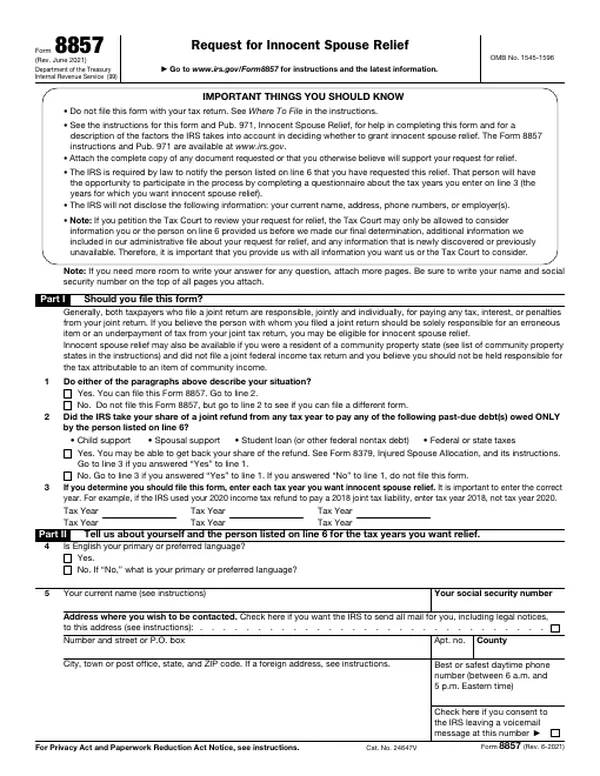
When to use Form 8857, and which relief applies
A joint return makes both spouses liable for the whole tax, including later deficiencies, even if a divorce decree assigns the debt to one of them. Form 8857 requests relief under IRC 6015 (joint returns) or IRC 66(c) (community property states, separate returns). The instructions describe four types:
| Relief | Key conditions (from the instructions) | Deadline |
|---|---|---|
| Innocent spouse, 6015(b) | Joint return; understated tax from the other spouse's erroneous items; the requesting spouse did not know and had no reason to know; unfair to hold them liable. Partial relief if they knew of an item but not its extent. | 2 years after the first IRS collection activity against the requesting spouse |
| Separation of liability, 6015(c) | Understated tax on a joint return; the spouses are divorced, legally separated, widowed, or lived apart for the 12 months before filing. No relief for items the requesting spouse actually knew about. No refunds. | 2 years after the first collection activity |
| Equitable relief, 6015(f) | Understated or unpaid tax; unfair to hold the requesting spouse liable. “Equitable relief is the only type of relief available for an unpaid tax.” | Balance due: within the collection period. Refund: 3 years from filing or 2 years from payment, whichever is later |
| Community income, 66(c) | No joint return; the item was the other spouse's income under section 879(a); the requesting spouse did not know; unfair to include it. | No later than 6 months before the assessment statute expires against the other spouse (30 days after an exam contact in that window) |
Collection activities that start the 2-year clock include a refund offset with notice of the right to relief, a claim in a court proceeding (including a bankruptcy proof of claim), a collection suit, and a section 6330 levy notice, which the instructions say the IRS usually sends as Letter 11 or Letter 1058. IRM 25.15.1.6.2 confirms that equitable relief is timely as long as the refund or collection statute is open.
Do not file if a court already decided relief in a final decision, the requesting spouse meaningfully participated in a proceeding where relief could have been raised, or the liability was settled by an offer in compromise or closing agreement. If the problem is a joint refund taken for the other spouse's separate debts, the right form is Form 8379, Injured Spouse Allocation (Part I, line 2 of Form 8857). The full framework is on innocent spouse, separation of liability and equitable relief.
Line by line
- Part I, 1-3Should you file this form?
- Line 1 confirms a joint return or community property situation. Line 2 screens for injured spouse cases. Line 3 lists up to six tax years, entering the year of the liability, not the year of the refund that was offset.
- Part II, 4-10About you and the person on line 6
- Language, current name, SSN, contact address (check the box to send all mail there), safe phone and voicemail consent; the other spouse's name, SSN and address; marital status with dates and attached decree, separation agreement or death certificate; education and tax or business coursework; mental or physical health problems at filing or now; and line 10, whether there is information the requester is afraid to put on the form but will discuss. The IRS will not disclose the requester's current name, address, phones or employer.
- Part III, 11-19Involvement with finances and returns
- Whether the requester intended to file jointly, involvement in preparing the returns, knowledge of the other spouse's income, knowledge of missing or incorrect items, how a balance due was to be paid, financial problems, role in household finances and accounts, large purchases or expenses, and asset transfers from the other spouse. This is where knowledge and reason to know are decided; answer each year if the facts differ.
- Part IV, 20-22Current financial situation
- Assets at fair market value with loan balances, household size, and average monthly household income and expenses by category. This feeds the economic hardship factor in equitable relief.
- Part V, 23a-23dAbuse or domestic violence
- Optional. A yes places a code on the requester's account. Describe the abuse and how it affected the ability to question the return or payment, and attach documentation such as protective orders, police or medical records, or third-party statements.
- Part VI, 24Additional information
- Anything else, including other years filed jointly with the same person.
- Part VII, 25Refund request
- Check to request a refund of amounts already paid if relief is granted. Refunds are available under 6015(b) and (f), not 6015(c).
- SignatureRequester and paid preparer
- Signed under penalties of perjury. The signer acknowledges that the IRS must contact the person on line 6. IRM 25.15.1.6: “A representative, authorized by a properly completed Form 2848, Power of Attorney and Declaration of Representative, may sign Form 8857 on behalf of a RS.” The Form 2848 must list innocent spouse relief or Form 8857 on line 3.
Where and how to file
| Method | Address or number (instructions and IRM 25.15.1.6.1) |
|---|---|
| U.S. Postal Service | Internal Revenue Service, P.O. Box 120053, Covington, KY 41012 |
| Private delivery service | Internal Revenue Service, 7940 Kentucky Drive, Stop 840F, Florence, KY 41042 |
| Fax | 855-233-8558 |
Do not file Form 8857 with the return or with the Tax Court. Send it to Covington or fax it even if the client is dealing with an examiner, Appeals or a revenue officer. The instructions add a warning for clients with a notice of deficiency: file a Tax Court petition within the 90 days and raise relief as a defense, because “The time for filing with the Tax Court is not extended while the IRS is considering your request.” Put the name and SSN on every attachment, and redact personal information about others that the requester does not want shared.
What the IRS does with it
Most requests are worked by correspondence in CCISO; if the requester is already under examination, the claim goes to the Area Office examiner and is considered with the deficiency (IRM 25.15.1.3). Any other office that gets a Form 8857 without an open exam or revenue officer case forwards it to CCISO within 10 business days.
The other spouse is always told. The instructions: “By law, the IRS must contact your spouse or former spouse. There are no exceptions, even for victims of spousal abuse or domestic violence.” The non-requesting spouse can submit information and receives the preliminary and final determinations. IRM 25.15.1.9.1 flags representing both spouses as a potential Circular 230 conflict of interest; see Circular 230 duties.
Collection stops against the requester only. Under IRM 25.15.1.7, certain collection actions against the requesting spouse are barred from the time the claim is filed until a waiver (Form 870-IS), the 90-day petition period expires, or a Tax Court decision is final, while “collection actions against the non-requesting spouse (NRS) during this period are not prohibited and should continue.” The CSED is suspended for that period plus 60 days (IRM 25.15.1.8). Interest and penalties keep accruing.
The IRS issues a preliminary determination letter; if neither spouse appeals to the Independent Office of Appeals, a final determination letter follows. Under IRC 6015(e) and IRM 25.15.1.10.2, the requester may petition the Tax Court within 90 days after the final determination, or any time after the claim has been pending 6 months without one. Scope of review is limited to the administrative record plus newly discovered or previously unavailable evidence, so the form and attachments need to carry the whole case. Relief can also be raised in a deficiency case or a CDP hearing.
Common rejections and mistakes
- Waiting past the 2-year window for 6015(b) or (c). Do not hold the form for documents.
- Letting the Tax Court deadline lapse on a notice of deficiency while the claim is pending.
- Using Form 8857 for an injured spouse problem. That is Form 8379.
- Representative signs without innocent spouse relief on the Form 2848. Then the client must sign.
- Thin Part III answers. The Tax Court may be limited to this record.
- Representing both spouses.
- Expecting a refund under separation of liability, which does not allow refunds.
- Sending it with the tax return or only to the examiner.
Questions practitioners ask
Will the IRS tell my client's former spouse about the request?
Yes. The instructions say the IRS must contact the spouse or former spouse, with no exceptions, but will not disclose the requester's current name, address, phone numbers, employer, income or assets.
What is the deadline for innocent spouse relief?
For 6015(b) and 6015(c), no later than 2 years after the first IRS collection activity against the requesting spouse. Equitable relief is timely while the collection statute (for a balance due) or the refund statute (for a refund) is open.
Does the IRS stop collecting while Form 8857 is pending?
From the requesting spouse, certain collection actions are prohibited until a waiver, the end of the 90-day petition period or a final Tax Court decision, and the CSED is suspended plus 60 days. Collection against the other spouse continues.
Can a representative sign Form 8857?
Yes, if the Form 2848 lists innocent spouse relief or Form 8857 on line 3. IRM 25.15.1.6 allows a properly authorized representative to sign for the requesting spouse.
When can my client go to the Tax Court?
Within 90 days after the IRS mails the final determination letter, or at any time after the claim has been pending for 6 months without a final determination.
Can one Form 8857 cover several years?
Yes. IRM 25.15.1.6 says the June 2021 form can request relief for up to six years, and more years can be added if the information is substantially the same. A separate form is needed for years involving a different spouse.