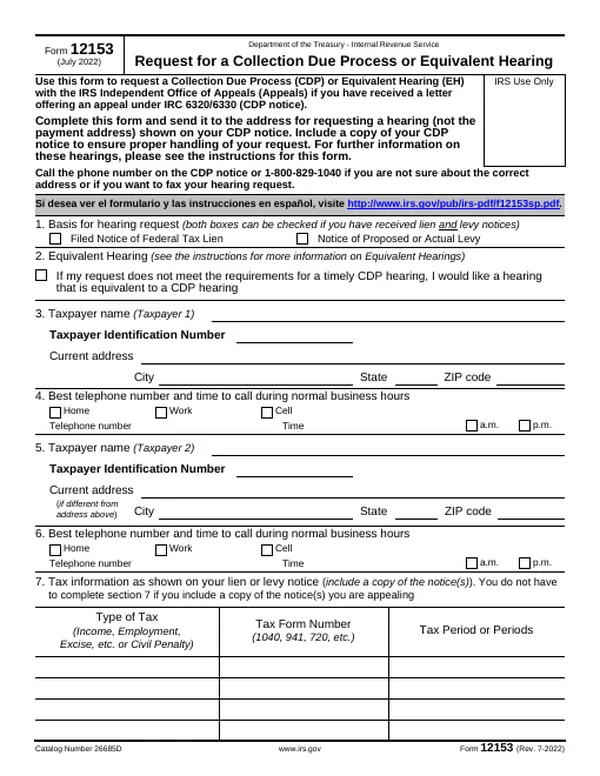
When to use Form 12153, and when another route is right
Form 12153 answers a CDP notice. Under IRC 6330, the levy notices include Letter 1058 and LT11, plus post-levy notices such as CP 92 or CP 242 for state refund levies, Letter 1058-D, Letter 1058-F and Letter 2439. Under IRC 6320, the lien notice is Letter 3172. The CDP right exists once per tax period for the levy notice and once for the first lien filing for that liability; a later notice for the same unpaid tax does not create a new hearing right unless new tax was assessed.
The deadlines are the reason the form exists. IRM 5.1.9.3.2 says a request must be filed on or before 30 days after the date of the levy notice, or on or before 30 days after the five-business-day period following the NFTL filing. Letter 3172 shows a must-file-by date. The IRM also warns employees to tell taxpayers that talking to Collection does not stop the clock: “Be sure to let taxpayers know that discussions with Collection do not suspend the running of (or otherwise extend) the 30-day period during which taxpayers may request a CDP hearing.”
Missed the 30 days? The same form, with box 2 checked, requests an equivalent hearing within one year. No CDP notice at all, or a decision on an installment agreement, lien certificate or seizure? That is the Collection Appeals Program on Form 9423. Both can be filed on the same event, but IRM 8.24.1.2 has Appeals ask the taxpayer to choose, and an issue decided in a completed CAP may be barred from a later CDP hearing. The broader process is on CDP hearings.
The form itself is not mandatory. Treas. Reg. 301.6330-1(c)(2) Q&A-C1 requires a dated written request that gives the taxpayer's name, address, daytime phone and TIN, the type of tax, the tax period, a statement that the taxpayer requests a hearing with Appeals concerning the proposed levy, the reasons for disagreement, and the signature of the taxpayer or authorized representative. IRM 5.1.9.3.2 follows the regulation: “If this form is not used, the taxpayer may submit a written request for a CDP hearing signed by the taxpayer or authorized taxpayer representative.” A letter with those elements, mailed to the notice address by the deadline, is a valid request; the form is simply the surest way to hit every element. The reverse step has a form too: Form 12256, Withdrawal of Request for Collection Due Process or Equivalent Hearing, which warns the signer that Appeals will issue no Notice of Determination and that the levy and statute suspensions end when the IRS receives it. IRM 5.1.9.3.3 adds that “A written request not on Form 12256 will also be honored.”
Line by line
- 1Basis for hearing request
- Filed Notice of Federal Tax Lien, Notice of Proposed or Actual Levy, or both if both notices were received. Appeals consolidates the two.
- 2Equivalent Hearing
- Check to ask for an equivalent hearing if the request turns out not to be timely for CDP. IRM 5.1.9.3.2.2: “Late CDP hearing requests are not automatically treated as EH requests.” Checking the box in every request costs nothing and protects the client if the CDP date was miscounted.
- 3-4Taxpayer 1 name, TIN, address, phone and best time to call
- As shown on the notice.
- 5-6Taxpayer 2
- For a joint liability. Each spouse gets a separate CDP notice and each must sign to request a hearing for themselves.
- 7Tax information
- Type of tax, form number and periods. Not required if a copy of the notice is attached. The IRM treats the request as covering every period on the notice unless the taxpayer excludes one.
- 8Reason you are requesting a hearing
- The form says the request will not be honored without a reason. Check the applicable boxes: not liable, innocent spouse (attach Form 8857), discharged in bankruptcy, payments not applied, lien withdrawal, financial hardship, collection alternative, or other. If “other” is checked, explain it. A liability challenge is allowed only if there was no deficiency notice and no earlier opportunity to dispute the amount, and Treas. Reg. 301.6330-1(e)(3) Q&A-E2 defines that opportunity broadly: “An opportunity to dispute the underlying liability includes a prior opportunity for a conference with Appeals that was offered either before or after the assessment of the liability.” A Letter 1153 proposing a trust fund recovery penalty is the common example; IRM 5.1.9.3.3 has Appeals check whether the letter was hand delivered or received by certified mail, and if it was, the TFRP amount cannot be argued at the CDP hearing. A pre-assessment Appeals offer on a tax subject to deficiency procedures does not count.
- 9Proposed collection alternative
- Installment agreement, offer in compromise, currently unable to pay, or other. Attach Form 433-A or 433-B unless an exception applies (a self-service installment agreement, or a doubt as to liability offer). Not required with the request, but the form says early submission speeds resolution.
- 10Signatures
- Taxpayer 1 and 2 (both for a joint request) or the representative, but not both. Officers add their title. A representative attaches a Form 2848 unless one is on file. The signer acknowledges that the hearing and any court review suspend the collection statute.
Where and how to file
Send the form to the hearing request address on the CDP notice, not the payment address, with a copy of the notice. To fax, call the number on the notice or 800-829-1040 for the fax number. IRM 5.1.9.3.2 also allows hand delivery to a Taxpayer Assistance Center within the 30 days and, for revenue officer cases, electronic submission by Document Upload Tool or secure messaging where available.
Timeliness rules from IRM 5.1.9.3.2 and 5.1.9.3.2.1:
- A request mailed to any address on the notice and postmarked on time is timely even if it arrives late. That includes the payment address: “If the hearing request was mailed to an address listed on the CDP notice (for example, the address for submitting payment rather than the address for mailing the request), the request should be considered timely if postmarked timely.”
- A request mailed to an address not on the notice is timely only if it reaches the notice address in time.
- When a revenue officer has the case, a request sent to the RO is measured by its postmark or the date the RO received it.
- IRC 7502 and 7503 apply: timely mailing is timely filing, weekend and holiday due dates roll to the next business day, and only the designated private delivery services count.
- Combat zone and disaster postponements under IRC 7508 and 7508A can extend the window.
Keep proof of mailing. The CDP deadline calculator computes both windows, and the CDP hearing request attachment template gives a structure for the reason statement.
What the IRS does with it
Collection receives the request first and makes the initial timeliness call, but Appeals makes the final determination; anything that looks late goes to Appeals for a separate timeliness determination.
Collection then checks whether the request is processable. Under IRM 5.1.9.3.2.3 a request is not processable only if it is unsigned, signed by someone without authority (an unenrolled preparer, a spouse, or a representative with no Form 2848 on file), has no identifiable TIN, or gives no reason. Collection makes a reasonable attempt to contact the taxpayer and generally allows 15 calendar days to fix it. Two rules protect practitioners: a timely request that was processable when received stays timely “even if the taxpayer perfects the request late or only perfects the request partially or does not respond”, and a timely but unprocessable request perfected within the allowed period is also timely. Electronic signatures are still not accepted as of the August 28, 2025 revision of IRM 5.1.9.3.2.3: “The regulations do not authorize a digital or electronic signature with a CDP hearing request.” Form 12153 is also absent from the list of forms in Exhibit 10.10.1-2 that may carry an electronic or digital signature under IRM 10.10.1.6.2. The narrow opening is IRM 10.10.1.6.1 (08-12-2024), which lets field collection and Appeals employees in authenticated person-to-person contacts accept “images of signatures and digital signatures on documents related to the determination or collection of a tax liability”; that is what makes a scanned, hand-signed Form 12153 sent to a revenue officer through the Document Upload Tool workable. A typed name or e-signature-software signature is not.
A timely levy CDP request suspends levy on the periods in the notice until the determination is final, except for jeopardy levies, state refund levies, federal contractor levies and disqualified employment tax levies (IRM 5.1.9.3.5.1). The collection statute is suspended from the date the request is received. IRC 6330(e)(1) suspends the levy and the periods under IRC 6502, 6531 and 6532 while the hearing and any appeal are pending, and adds a floor: “In no event shall any such period expire before the 90th day after the day on which there is a final determination in such hearing.” Treas. Reg. 301.6330-1(g) and IRM 5.1.9.3.6 apply the same 90-day minimum, measured from the withdrawal or from the date the Notice of Determination becomes final, so a CSED that would have run during the hearing is pushed at least 90 days past the end of it. A lien can still be filed; the form says a levy hearing request “does not prohibit the IRS from filing a notice of federal tax lien.” An equivalent hearing does not suspend the collection statute or bar levy by law.
In Appeals, IRM 8.6.1.2 has the hearing officer verify the statute and send the acknowledgment letter within 30 days for CDP cases. The determination weighs whether legal and procedural requirements were met, the issues raised, and whether the proposed action balances efficient collection against intrusiveness (IRM 5.1.9.3.9). A timely CDP hearing ends in a Notice of Determination, and IRM 5.1.9.3.10 states: “After Appeals makes its determination in a CDP hearing, the taxpayer may, within 30 days of the date of the determination letter, petition the Tax Court.” An equivalent hearing ends in a decision letter with no Tax Court review, except for innocent spouse and interest abatement issues and disputes over timeliness.
The 30 days are not jurisdictional. In Boechler, P.C. v. Commissioner, 596 U.S. 199 (2022), the Supreme Court held that the deadline in IRC 6330(d)(1) “is an ordinary, nonjurisdictional deadline subject to equitable tolling”, so a petition filed late for a reason outside the taxpayer's control can ask the Tax Court to toll the period rather than being dismissed automatically; whether tolling is warranted is decided on the facts. IRM 5.1.9.3.9 now lists, among the EH decision letter situations that can reach court, one where “the taxpayer claims the deadline should be extended due to equitable tolling”. Treat the 30 days as firm anyway: tolling is a fallback argument, not a filing plan. See Tax Court petitions and the petition deadline calculator.
Common rejections and mistakes
- Counting the lien window from the letter date. The lien clock runs from the end of the five-business-day period after the NFTL filing; use the date printed on Letter 3172.
- No reason given, or “other” checked with nothing written.
- Representative signs without a Form 2848 on file or attached.
- Electronic signature. Get a wet signature; a scan of it is acceptable to a revenue officer or Appeals, a typed or software signature is not.
- Not checking box 2. A late request is not converted to an equivalent hearing unless the taxpayer asks.
- Raising a liability already decided in a deficiency case or prior Appeals hearing, or one the client could have taken to Appeals after a Letter 1153 and did not (Treas. Reg. 301.6330-1(e)(3) Q&A-E2).
- Frivolous positions. The IRS can disregard those portions or deny the hearing.
- Leaving out the financial statement when the goal is an installment agreement or offer, which slows the hearing.
Questions practitioners ask
Is the 30-day CDP deadline counted from the date on the levy notice?
Yes for levy notices. IRM 5.1.9.3.2.1 says the 30-day period begins the day after the date of the CDP levy notice. For lien notices, it runs for 30 days after the five-business-day period following the NFTL filing, and Letter 3172 shows the date.
What if the request was mailed to the payment address on the notice?
IRM 5.1.9.3.2 treats a request mailed to any address listed on the CDP notice, including the payment address, as timely if it was postmarked on time.
Can the representative sign Form 12153 instead of the client?
Yes. Either the taxpayer or the representative signs, not both. The representative needs a Form 2848 on file or attached; otherwise the request is not processable until fixed.
Does a CDP request stop the IRS from filing a lien?
No. A levy CDP request suspends most levies on the periods in the notice, but the form and IRM 5.1.9.3.5 say the IRS may still file a notice of federal tax lien.
What is the difference between a CDP hearing and an equivalent hearing?
They are conducted the same way, but an equivalent hearing does not suspend the collection statute or prohibit levy by law, and its decision letter generally cannot be taken to Tax Court.
How long do I have to go to Tax Court after the hearing?
30 days from the date of the Notice of Determination. Appeals holds the case for 60 days after issuing it to allow for a petition. After Boechler, P.C. v. Commissioner, 596 U.S. 199 (2022), a late petition can ask the court for equitable tolling, but the Court left whether tolling applies to the facts of each case, so file within the 30 days.
Do I have to use Form 12153, or will a letter do?
A letter works if it has every element in Treas. Reg. 301.6330-1(c)(2) Q&A-C1: name, address, phone, TIN, type of tax, period, a statement requesting an Appeals hearing on the levy or lien, the reasons, and a signature, all dated. IRM 5.1.9.3.2 says the same. The form is the safer vehicle because it prompts for each element and for the equivalent hearing box.
How does a CDP request change the collection statute?
A timely CDP request suspends the CSED from the day the IRS receives it until the determination is final or the request is withdrawn, and IRC 6330(e)(1) guarantees the statute will not expire before the 90th day after the determination becomes final. An equivalent hearing does not suspend the CSED.