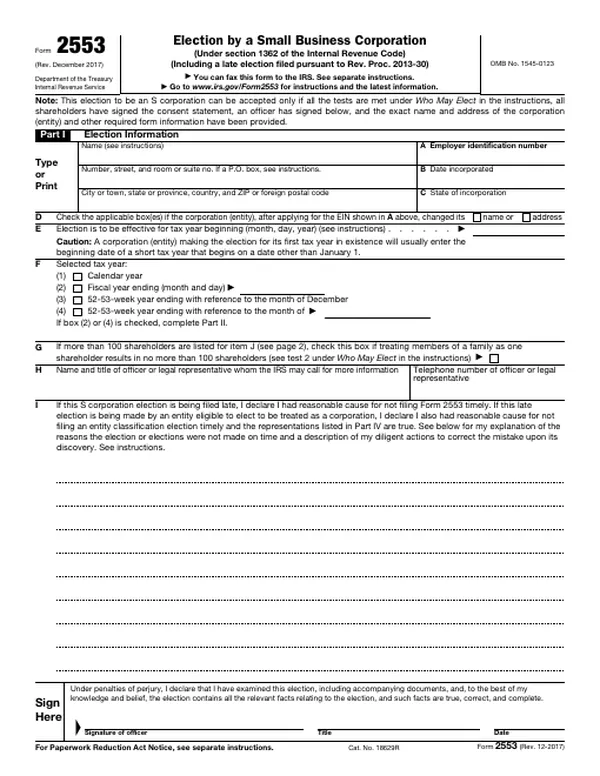
When to use Form 2553 (and when another form is right)
The instructions say a corporation or other entity eligible to elect to be treated as a corporation “must use Form 2553 to make an election under section 1362(a) to be an S corporation.” An LLC electing S status does not need a separate entity classification election: the instructions say it will be treated as a corporation as of the S election's effective date and “doesn't need to file Form 8832.” IRM 3.13.2.23 calls this a deemed Form 8832 election, posted with TC 074. See Form 8832.
The eligibility tests in the instructions are the ones the IRS checks on receipt: a domestic corporation or eligible entity; no more than 100 shareholders (family members may be treated as one); only individuals, estates, certain trusts and exempt organizations as shareholders; no nonresident alien shareholders; one class of stock; not an ineligible corporation; a permitted tax year; and every required shareholder consent.
Related situations use different procedures. A wholly owned subsidiary of an S corporation uses Form 8869 (QSub). An ESBT election is made by statement, and a QSST election can be made in Part III or separately; see late QSub, ESBT and QSST elections. An election that terminated by accident is fixed under IRC 1362(f), not a new Form 2553; see inadvertent terminations.
Timing. File no more than 2 months and 15 days after the beginning of the tax year the election is to take effect, or at any time during the preceding tax year. IRM 3.13.2.23.3 states the processing rule: “A taxpayer is timely with their S-election if their Form 2553 is received before the 16th day of the third month of their tax year.” The instructions' examples show the count runs from the day the tax year begins: a calendar-year corporation beginning January 7 must file between January 7 and March 21.
Item by item
- NameName and address
- The true name in the charter or organizing document, with C/O if mail goes to someone else. A name that differs from IRS records triggers correspondence or Secretary of State verification (IRM 3.13.2.23.1).
- AEmployer identification number
- The entity's EIN. If one has been applied for but not received, enter Applied For and the date. IRM 3.13.2.23.1 has Entity research a missing or wrong EIN and, in some cases, assign one.
- B, CDate incorporated; State of incorporation
- An S election cannot be effective before the date of incorporation; Entity edits the effective date if it is earlier.
- DName or address change
- Check if the name or address changed after the EIN was obtained.
- EElection is to be effective for tax year beginning
- For a first-year entity, the earliest of when it first had shareholders, first had assets, or began doing business, usually not January 1. An existing corporation enters the first day of the tax year the election is to take effect.
- FSelected tax year
- Calendar year, fiscal year, or a 52-53-week year. Boxes 2 or 4 require Part II.
- GMore than 100 shareholders
- Check if treating family members as one shareholder brings the count to 100 or fewer.
- HName and title of officer or legal representative
- The contact the IRS may call; IRM 3.13.2.23.1 has Entity try this contact before returning an incomplete form.
- ILate election reasonable cause statement
- For a late election, the declaration and the explanation of why the election was not timely and what was done to correct it once discovered. IRM 3.13.2.23.1: entering the revenue procedure requirements alone does not satisfy this; the reasons must be explained.
- SignSignature of officer
- The president, vice president, treasurer, assistant treasurer, chief accounting officer or other authorized officer. The instructions: “If Form 2553 isn't signed, it won't be considered timely filed.”
- JName and address of each shareholder or former shareholder required to consent
- Shareholders on the date of filing; for an election filed on or after the effective date, everyone who owned stock from the effective date to the filing date. For a disregarded single-member LLC shareholder, the owner.
- KShareholder's Consent Statement
- Each consenting shareholder signs and dates. Both spouses with a community interest, every joint tenant and tenant in common, and the proper party for minors, estates and trusts must consent. For late elections, the consent also declares income was reported consistently with S status.
- L, M, NStock owned or percentage; SSN or EIN; tax year end
- Shares or ownership percentage and acquisition dates (LLCs use percentages), each shareholder's TIN, and the month and day each shareholder's tax year ends.
- Part IISelection of Fiscal Tax Year (items O to R)
- O: new, retaining or changing. P: automatic approval under Rev. Proc. 2006-46 for a natural business year (47 months of gross receipts) or ownership tax year. Q: business purpose request under Rev. Proc. 2002-39, with a user fee, and optional back-up section 444 election. R: section 444 election with Form 8716.
- Part IIIQualified Subchapter S Trust (QSST) Election
- The income beneficiary's election under section 1361(d)(2), usable only if the stock was transferred to the trust on or before the date of the S election.
- Part IVLate Corporate Classification Election Representations
- For an entity that also missed its classification election, the five representations required for combined relief, including that it filed consistently with S status (5a) or has not yet reached its first return due date (5b).
Signatures must be originals. IRM 3.13.2.23.1 says fax signatures are acceptable on Form 2553 for any signature field, but “Electronic, digital, or stamped signatures are not acceptable for an election.”
Where and how to file
Send the original (no photocopies) or fax it to the service center for the entity's principal business location. If faxed, keep the original with the corporate records. Per the December 2020 instructions:
| Principal business, office or agency in | Mail to | Fax |
|---|---|---|
| CT, DE, DC, GA, IL, IN, KY, ME, MD, MA, MI, NH, NJ, NY, NC, OH, PA, RI, SC, TN, VT, VA, WV, WI | Department of the Treasury, Internal Revenue Service Center, Kansas City, MO 64999 | 855-887-7734 |
| AL, AK, AZ, AR, CA, CO, FL, HI, ID, IA, KS, LA, MN, MS, MO, MT, NE, NV, NM, ND, OK, OR, SD, TX, UT, WA, WY | Department of the Treasury, Internal Revenue Service Center, Ogden, UT 84201 | 855-214-7520 |
The instructions caution that filing information is subject to change and point to the IRS where-to-file page for Form 2553. Note that the more recent Form 8832 mailing update lists Tennessee under Ogden; check the current IRS page before mailing a Tennessee election. Acceptable proof of filing includes a certified or registered mail receipt, a designated private delivery service record, a Form 2553 with an accepted or received stamp, or an IRS acceptance letter. IRM 3.13.2.23.3 adds that a fax confirmation showing the correct service center number and a timely date is accepted as proof.
A late election can also be attached to Form 1120-S when all earlier returns have been filed, with “INCLUDES LATE ELECTION(S) FILED PURSUANT TO REV. PROC. 2013-30” across the top of the return, in addition to the legend on the Form 2553.
What the IRS does with it
Entity processes the form for completeness, eligibility and timeliness before posting it (IRM 3.13.2.23). Approval posts TC 090 and generates CP 261, Notice of Acceptance; denial posts TC 094 and generates CP 264, Notice of Non-Acceptance as an S Corporation, with reason paragraphs such as filing after the tax year ended, more than one class of stock, more than 100 shareholders or an ineligible shareholder. The instructions say the corporation should generally get a determination within 60 days, or about 90 more days when box Q1 is checked, and to call 1-800-829-4933 if no notice arrives within 2 months (5 months with Q1).
A late election is not simply rejected. IRM 3.13.2.23.3 says “A late filed Form 2553 will be approved for the next qualifying tax year, provided all eligibility and completeness criteria are met,” and the CP 261 paragraphs then tell the taxpayer how to request relief under Rev. Proc. 2013-30 for the intended date. Relief requires filing within 3 years and 75 days of the item E date, reasonable cause and diligent correction, and consistent reporting statements from all shareholders, with “FILED PURSUANT TO REV. PROC. 2013-30” at the top of the form. Outside those limits, the route is a private letter ruling with a user fee. See late S election relief and Section 9100 relief.
Incomplete forms are returned rather than held. IRM 3.13.2.23.1 has Entity try to call the taxpayer or the item H contact first, then return the form for completion with Letter 312C or Letter 6800sce, noting it with TC 093 and TC 092.
Common reasons elections are rejected
- Missing shareholder consents, including a spouse with a community property interest or a former shareholder from the effective date to the filing date.
- Officer signature missing or digital; an unsigned form is not timely.
- Wrong effective date: before incorporation, or not the first day of an existing corporation's tax year. Entity edits it, which may move S status to a later year.
- Ineligible shareholder, such as a nonresident alien, a partnership or a corporation.
- Name or EIN mismatch with IRS records, which leads to correspondence and delay.
- Late filing without the Rev. Proc. 2013-30 legend, explanation and consistency statements.
- Fiscal year requested without Part II. CP 261 paragraph B accepts the election but not the fiscal year unless Form 8716 is accepted.
Questions practitioners ask
When is Form 2553 due?
No more than 2 months and 15 days after the start of the tax year the election is to take effect, or any time in the preceding tax year. IRM 3.13.2.23.3 treats it as timely if received before the 16th day of the third month of the tax year.
Does an LLC need to file Form 8832 before Form 2553?
No. The instructions say an eligible entity that timely files Form 2553 and meets the tests is treated as a corporation without filing Form 8832; IRM 3.13.2.23 calls this a deemed election.
What happens if Form 2553 is filed late?
Without relief, IRM 3.13.2.23.3 says it is approved for the next qualifying tax year. To get the intended date, request relief under Rev. Proc. 2013-30 within 3 years and 75 days, or seek a private letter ruling.
Can Form 2553 be signed electronically?
No. IRM 3.13.2.23.1 says electronic, digital or stamped signatures are not acceptable for an election, although faxed signatures are.
How do I prove the election was filed?
The instructions accept a certified or registered mail receipt, a designated private delivery service record, a stamped Form 2553, or an IRS acceptance letter. A fax confirmation to the correct number is accepted under IRM 3.13.2.23.3.