When to use Form 656 (and when another form is right)
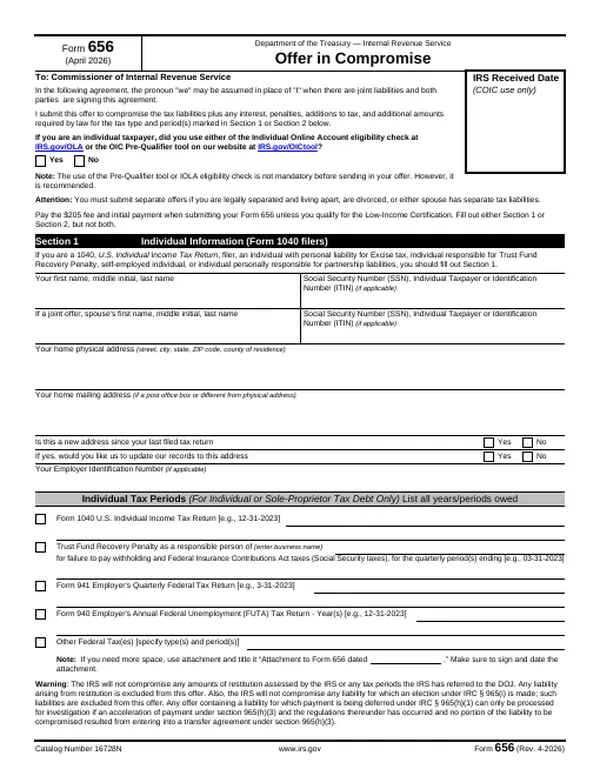
Form 656 is used for offers based on doubt as to collectibility and both kinds of effective tax administration offer (economic hardship, and public policy or equity). An offer based on doubt as to liability uses Form 656-L instead, and the booklet warns not to submit a liability offer and a collectibility or ETA offer at the same time. See doubt as to liability offers and effective tax administration offers.
The booklet's eligibility test comes first. Before an offer can be considered, the taxpayer must have filed all required returns, received a bill for at least one liability on the offer, made required estimated payments for the current year and, for an employer, made required federal tax deposits for the current quarter and the two preceding quarters. An open bankruptcy makes the taxpayer ineligible. And the booklet states the economic reality plainly: “Generally, the IRS will not accept an offer if you can pay your tax debt in full through an installment agreement and/or equity in assets.” Run the numbers first with the RCP calculator or the IRS pre-qualifier, and see reasonable collection potential.
The Form 656 that IRS posts on its own carries a warning that it is not a stand-alone form and is for tax professional use; individuals use the complete Form 656-B booklet, which contains Form 433-A (OIC), Form 433-B (OIC), Form 656 and the application checklist.
Section by section
- TopPre-qualifier question
- Whether an individual used the Individual Online Account eligibility check or the OIC Pre-Qualifier tool. Not mandatory, but the form recommends it.
- Sec. 1Individual Information (Form 1040 filers)
- Names, SSN or ITIN, physical and mailing address, whether to update the address, EIN if any, and every period owed: Form 1040 years, Trust Fund Recovery Penalty quarters (with the business name), Forms 941 and 940 for a sole proprietor, and other federal taxes. Fill out Section 1 or Section 2, not both.
- LICLow-Income Certification
- Individuals and sole proprietors only. Check a box if adjusted gross income, or household gross monthly income from Form 433-A (OIC) times 12, is at or below the table for family size and location; for example, $39,900 for a household of one and $82,500 for four in the 48 contiguous states, D.C. and territories (Form 656, Rev. April 2026). Qualifying waives the fee and the payments during consideration.
- Sec. 2Business Information (Form 1120, 1065, etc., filers)
- Business name, addresses, EIN, primary contact, and each period owed (Form 1120, 941, 940 and other taxes). Requires Form 433-B (OIC), the $205 fee and the initial payment.
- Sec. 3Reason for Offer
- Check only one: Doubt as to Collectibility (offering at least the minimum computed on Form 433-A (OIC) or 433-B (OIC)); Effective Tax Administration, Economic Hardship (individuals only); or Effective Tax Administration, Public Policy or Equity. ETA offers and below-minimum collectibility offers need a detailed attached explanation.
- Sec. 4Payment Terms
- Lump Sum: 5 or fewer payments within 5 or fewer months of acceptance, with 20% of the offer sent with the application and the remaining payments scheduled. Periodic Payment: paid within 6 to 24 months, first payment with the offer and the rest monthly while the offer is considered. The offer must be more than $0, in whole dollars.
- Sec. 5Designation of Payment and EFTPS
- Designate the tax period and type to which the initial payment applies (the fee cannot be designated), and list fee and payment EFTPS or IOLA transfer numbers. Electronic payments must be made the same date the offer is mailed or filed online.
- Sec. 6Source of Funds, Making Your Payment, Filing Requirements, and Tax Payment Requirements
- Where the offer money will come from; separate payments for the fee and the offer payment; certification that all returns are filed (with a copy of any return filed within 10 weeks); and estimated tax and federal deposit compliance.
- Sec. 7Offer Terms
- The contract terms, (a) through (x), including the five-year compliance period, keeping refunds and payments, no amended returns for offer years, the assessment statute waiver, CSED suspension, lien filing, public inspection and the 30-day window to appeal a rejection.
- Sec. 8Signatures
- Taxpayer and spouse, or the corporation and an authorized officer, under penalties of perjury.
- Sec. 9Paid Preparer Use Only
- Preparer signature, name, CAF number or PTIN and firm. To represent the taxpayer during the investigation, attach a signed Form 2848 that includes the current tax year.
Section 7(p) is an assessment statute waiver. By submitting the offer the taxpayer agrees that the assessment period runs for the time the offer is pending plus one more year if the offer is rejected, returned, terminated or withdrawn. The same paragraph says the collection statute is suspended while the offer is pending, for 30 days after a rejection, and while a rejection is in Appeals. The form terms track the Code: IRC 6331(k)(1) bars a levy while an offer is pending and for 30 days after a rejection (longer if a timely appeal is filed), and IRC 6331(k)(3), by applying IRC 6331(i)(5), suspends the collection statute “for the period during which the Secretary is prohibited under this subsection from making a levy.” Reg. 301.7122-1(g)(1) states the same levy bar. See what suspends the CSED.
When the offer becomes pending. The protections above start on the pending date, and that is not the mailing date. IRC 6331(k)(1) says an offer “is pending beginning on the date the Secretary accepts such offer for processing,” Reg. 301.7122-1(d)(2) says “An offer to compromise becomes pending when it is accepted for processing,” and Section 7(j) of the form puts it in contract terms: once an authorized IRS official signs the form, the offer is pending as of that signature date. IRM 5.8.2.4.1 tells the process examiner that “An OIC is considered pending when a delegated IRS official signs and dates the Form 656. This date is the official offer pending date,” and that it must match the TC 480 date on the account. Two different clocks therefore run from two different dates: the levy bar and CSED suspension from the signature date, and the 24-month deemed acceptance period of IRC 7122(f) from receipt at the COIC site (Section 7(b); IRM 5.8.2.4).
Two more terms surprise clients. Under 7(e), the IRS keeps any refund for tax assessed before acceptance, and the taxpayer agrees not to file amended returns for the offer years (details below). Under 7(l), the taxpayer must file and pay on time for five years after acceptance, and cannot request an installment agreement or another offer during that period. The April 2026 form states it directly: “I also understand that during the five year period I cannot request an installment agreement for unpaid taxes incurred before or after the accepted offer. I understand that I cannot request an offer for a tax liability during the five year period.”
Refunds, before and after acceptance. The refund term changed in 2021. Earlier versions of Form 656 had the IRS keep refunds for tax periods extending through the calendar year in which the offer was accepted. The IRS explained the change on IRS.gov: “Beginning with offers accepted on or after November 1, 2021, the IRS generally will not offset refunds to tax periods included on the offer after the offer acceptance date.” The April 2026 Section 7(e) now reads: “The IRS will keep any refund, including interest, that I might be due for tax assessed before the date the IRS accepts my offer.” The booklet's example: a 2024 return filed April 15, 2025 and assessed May 26, 2025 has its overpayment offset before an offer accepted July 1, 2025, so that refund reduces the liability and “is not considered as a payment toward your offer.” Refunds still offset while the offer is pending, but 7(e) notes that hardship assistance may be available; the IRS page confirms that taxpayers “may also request an Offset Bypass Refund, or OBR, while their Offer in Compromise is being considered by the IRS.” Refunds from amended returns for years ending before acceptance are offset, and a refund received before acceptance must be returned within 30 days. See refund offsets.
Where and how to file
Individuals can apply through the Individual Online Account, which prepares the forms, computes a potential offer and takes the payments. Paper packages go to the Centralized Offer in Compromise (COIC) unit for the taxpayer's state. The table below is checked against page 29 of Form 656-B (Rev. 4-2026), the Application Checklist, which tells filers who applied online not to mail a duplicate:
| If the taxpayer resides in | Mail to |
|---|---|
| AL, AZ, CA, CO, GA, HI, ID, KY, LA, MD, MS, ND, NM, NV, OK, OR, SD, TN, TX, UT, VA, WA | Memphis IRS Center COIC Unit, P.O. Box 30803, AMC, Memphis, TN 38130-0803 (844-398-5025) |
| AK, AR, CT, DC, DE, FL, IA, IL, IN, KS, MA, ME, MI, MN, MO, MT, NC, NE, NH, NJ, NY, OH, PA, PR, RI, SC, VT, WI, WV, WY, or a foreign address | Brookhaven IRS Center COIC Unit, P.O. Box 9007, Holtsville, NY 11742-9007 (844-805-4980) |
The package is Form 656, the signed Form 433-A (OIC) and/or 433-B (OIC) with copies (not originals) of the listed documents, the $205 fee and the initial payment unless the low-income certification applies. Pay the fee and payment separately, by EFTPS, the Individual Online Account, or separate checks to the United States Treasury. Spouses with separate liabilities, ex-spouses, and anyone with both individual and business debt file separate Forms 656, each with its own fee. Our offer in compromise checklist follows the booklet's checklist item by item.
What the IRS does with it
A COIC process examiner first decides whether the offer is processable. Under IRM 5.8.2.4, an offer received with payment gets a processability decision “within 24-hours of IRS received date,” and case building follows within 20 calendar days. IRM 5.8.2.4.1 lists the not-processable conditions: open bankruptcy, liabilities referred to the Department of Justice, no liability, only expired CSEDs, unassessed periods, unfiled returns, missing fee or payment without a low-income certification, and a liability already in another open offer. When an offer is not processable, the fee is generally returned and the payment is applied to the liability, except that both are returned for bankruptcy and the other listed exceptions.
The distinction between kinds of closures matters because appeal rights and the statute depend on it. IRM 5.8.7.2 explains that an offer can be returned as a not-processable return or a processable return, and “when there is a not processable return, the collection statute is not suspended.” Returned offers cannot be appealed; rejected offers can, within 30 days of the rejection letter under Section 7(k). The appeal is made on Form 13711, Request for Appeal of Offer in Compromise, or a letter with the same content. IRM 5.8.7.7.5 says “Any request for Appeals consideration must include a written, signed protest in accordance with guidance provided in the rejection letter issued to the taxpayer. The rejection letter and the Form 13711, Request for Appeal of Offer in Compromise, contain the required language.” Form 13711 asks for each disagreed item from the income and expense table and the asset and equity table that came with the rejection letter, the reason for disagreement with supporting documents, and a penalties of perjury certification; a representative signs a declaration stating whether they have personal knowledge of the facts. Pub 5 adds that for an offer the amount in dispute “includes total unpaid tax, penalty and interest due,” which decides whether a formal protest is needed. Timeliness follows the postmark and next-business-day rules in IRM 5.8.7.7.5, and an unsigned or incomplete appeal gets one chance, no more than 15 calendar days, to be perfected. Missing a periodic payment is a return: IRM 5.8.7 tells employees to warn taxpayers that failing to keep up with periodic payments “may result in the offer being closed as a return or involuntary withdrawal with no appeal rights.”
If the IRS does nothing, the statute does it for the taxpayer. IRC 7122(f) provides that an offer is deemed accepted if not rejected within 24 months after submission, excluding any period a liability is in dispute in court, and IRM 5.8.1.13 repeats: “If the IRS does not make a determination on an offer within 24 months, the offer will be deemed accepted.”
Common reasons offers come back
- Unfiled returns. Not processable; the payment is applied and only the fee is returned, with no appeal.
- No bill yet. The booklet says an offer may be returned if the taxpayer has not received a bill for at least one liability on it; include a copy of any return filed within 10 weeks.
- Missing fee or 20% payment without a low-income certification.
- Both Section 1 and Section 2 completed, or individual and business debts on one Form 656.
- Offer below the Form 433-A (OIC) minimum with no special-circumstances explanation attached.
- Missed periodic payments or late replies to document requests during the investigation, which lead to a return without appeal rights.
- Payments from an expected refund or levied funds, which Section 7(f) says cannot be part of the offer amount.
Questions practitioners ask
Is the $205 fee refunded if the offer is rejected?
No. Section 7(c) says the IRS keeps the application fee unless the offer is not accepted for processing. Under IRM 5.8.2.4.1, the fee is returned when an offer is found not processable.
Can a rejected offer be appealed?
Yes. Section 7(k) says the taxpayer waives an Appeals hearing if a written request is not made within 30 days of the rejection notice. Use Form 13711 or a signed protest with the same elements: the disagreed items, the reasons with documentation, and the penalties of perjury statement (IRM 5.8.7.7.5; Pub 5). A returned offer has no appeal rights. See Collection Appeals and the Independent Office of Appeals.
Does the IRS keep levying while the offer is pending?
No, once it is pending. IRC 6331(k)(1) bars a levy while the offer is pending and for 30 days after a rejection, and the pending date is the date the IRS accepts the offer for processing, not the mailing date. Section 7(g) says the IRS may levy up to the time an IRS official signs and acknowledges the offer as pending, and may keep levy proceeds. The booklet adds that an approved installment agreement does not need to be paid while the offer is considered and is reinstated if the offer fails and no new debt has accrued.
Will the IRS keep my client's refund for the year the offer is accepted?
Not for offers accepted on or after November 1, 2021. The IRS now keeps refunds for tax assessed before the acceptance date (Section 7(e), Rev. 4-2026) and generally does not offset later refunds to the compromised periods. Refunds can still be offset while the offer is pending, and a taxpayer in hardship can ask for an offset bypass refund during that time.
What happens if the client files an amended return for an offer year?
Section 7(e) says the taxpayer agrees not to file amended returns for offer years while the offer is pending or after acceptance, and that doing so could be grounds for termination.
Does submitting an offer extend the assessment statute?
Yes. Section 7(p) extends the assessment period by the time the offer is pending plus one year if it is rejected, returned, terminated or withdrawn. The collection statute is also suspended while it is pending.
Who qualifies for the low-income certification?
Individuals and sole proprietors whose AGI, or household gross monthly income times 12, is at or below the Form 656 table for their family size and location. Businesses other than sole proprietors and offers for deceased individuals do not qualify.