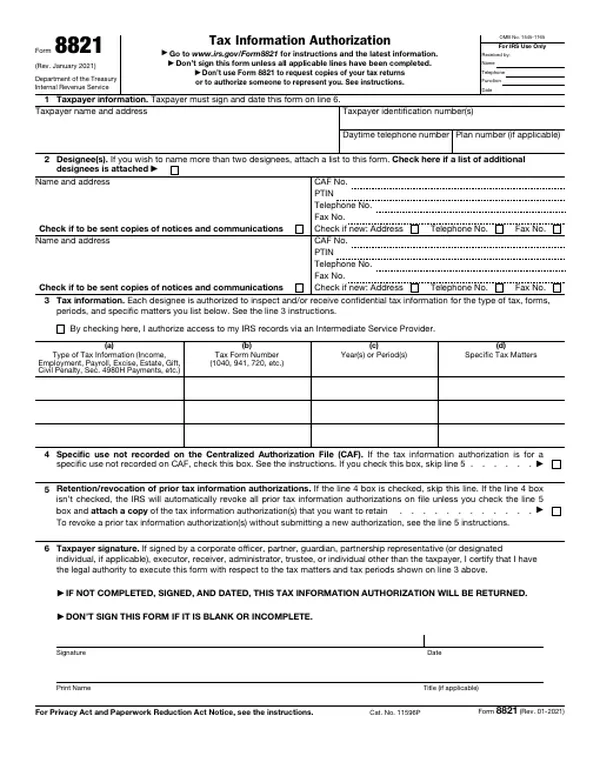
When to use Form 8821, and when another form is right
Form 8821 is a disclosure consent under IRC 6103(c). The designee can inspect and receive information, in writing or verbally, for the type of tax, forms and periods on line 3. The instructions spell out what it does not do: “Form 8821 doesn't authorize your designee to speak on your behalf”, sign waivers, consents or closing agreements, or advocate the taxpayer's position. The designee cannot substitute another party either.
Typical uses in a practice:
- Pulling transcripts through the Transcript Delivery System before an engagement starts, or for a client who does not need representation.
- Giving a bookkeeping firm, payroll provider or offshore support team access to notices and account data. A business can be the designee, and the IRM says naming a business covers all its employees without a list.
- Letting an unenrolled preparer who does not meet the representation requirements see the account. The Form 2848 instructions point those preparers to Form 8821.
- Lender or program income verification, subject to the 120-day rule below.
For an individual client, the paper form is often the slow route. The instructions open with a tip to use the all-digital Tax Pro Account, where most requests record immediately to the CAF, and IRM 21.3.7.1.7 describes it as an online system for requesting a TIA or POA for an individual taxpayer in lieu of filing the paper form. Unlike a POA request, which is limited to attorneys, CPAs, enrolled agents, enrolled actuaries and enrolled retirement plan agents, the IRS page says “Anyone can request TIA and view taxpayer information with Tax Pro Account.” The client must have a U.S. state or D.C. address that matches IRS records and must be able to sign in to an IRS online account to approve the request; the request can cover Form 1040 income tax, innocent spouse relief, shared responsibility payments and civil penalties for the last 20 years plus 3 future years. A Tax Pro Account request revokes prior authorizations for the same matters, periods and type, so use the paper form with the line 5 box checked when an existing designee must stay on.
Use Form 2848 when the third party will negotiate, sign or argue. Use Form 4506-T when the taxpayer only needs a transcript mailed to their own address, and Form 4506 for a copy of a filed return. The two authorization forms are compared on Form 2848 vs Form 8821, and the limited alternatives are on third party designee and oral disclosure.
A taxpayer does not need Form 8821 to see their own information. IRM 21.3.7.5.3 says “The CAF processing sites will not process Form 8821 when line one, Taxpayer information and line two, designee are the same.” Where it is clear a taxpayer filed one on themselves out of identity theft concern, the rejection letter encloses Publication 5027.
Line by line
- Line 1Taxpayer information
- Name, TIN, address, daytime phone and plan number if applicable. Each spouse on a joint return files their own Form 8821. Corporations, partnerships and associations enter the entity name, EIN and business address; trusts enter the trustee's name and title plus the trust's name and EIN; an estate without its own TIN uses the decedent's SSN or ITIN. For trusts and estates the fiduciary has to be on the IRS record before the form arrives: the instructions say a trust that has not already filed Form 56 identifying the current trustee must submit one, and for an estate “A Form 56 should be filed to identify the executor.” IRM 21.3.7.5.1 has the CAF examiner compare a fiduciary signer to the second name line on the entity record and, if there is no match, “reject the authorization and request Durable Power of Attorney, court appointment papers, guardianship papers or Form 56.” See Form 56. The address here does not change the last known address.
- Line 2Designee(s)
- Name, address, CAF number, PTIN, phone and fax for two designees. Check the box at the top and attach a list to name more. Enter “NONE” if a designee has no CAF number and the IRS will assign one. The notice box under each designee sends copies of notices; no more than two designees can receive them for the same matter. The box moved to line 2 in the January 2021 revision.
- Line 3Tax information
- Columns (a) type of tax information, (b) form number, (c) years or periods and (d) specific tax matters. General references such as all years are returned. Future periods are recorded only up to 3 years after December 31 of the year received. A listed return carries its return-related penalties; a non-return penalty such as the section 4980H payment needs “civil penalties” or the specific penalty in column (a). Use column (d) to limit the scope (balance due, lien information) or enter “not applicable” for no limit. Check the box on this line to allow access through an Intermediate Service Provider.
- Line 4Specific use not recorded on CAF
- For uses the CAF does not record, such as disclosure to a lender or school, background checks, or information about Forms SS-4, W-2, W-4, W-7, 843, 966, 1096, 1098, 1099, 1128, 2553 or 4361. Form 8802 residency requests go here with “Form 8802” in column (d). A line 4 form goes to the office handling the matter and does not revoke earlier authorizations. If line 4 is checked, skip line 5.
- Line 5Retention/revocation of prior tax information authorizations
- If left blank, the IRS revokes all prior tax information authorizations on file. To keep one, check the box and attach a copy. The instructions also explain revoking without a new form: write “REVOKE” across the top with a current signature and date, or send a signed statement naming the designee, matters and periods.
- Line 6Taxpayer signature
- Signature, date, printed name and title. Mail and fax filings require a handwritten signature. Corporate officers, partners, the PR or designated individual, executors, receivers, administrators and trustees certify their authority by signing. An executor should also have a Form 56 on file.
Where and how to file
The routes match Form 2848: online at IRS.gov/Submit8821 (required for electronic signatures), or by fax or mail to the CAF unit for the taxpayer's state. The September 2021 instructions say the online route needs a Secure Access account; that sign-in has since been retired, and the IRS account page now says you need “an account with ID.me to sign in” for Forms 2848 and 8821 online. The submission page adds that a submitter who has no personal or business relationship with the taxpayer must authenticate the taxpayer's identity before uploading a form that was e-signed remotely; the steps are on the Form 2848 page.
| Taxpayer location | Address | Fax |
|---|---|---|
| AL, AR, CT, DE, DC, FL, GA, IL, IN, KY, LA, ME, MD, MA, MI, MS, NH, NJ, NY, NC, OH, PA, RI, SC, TN, VT, VA, WV | Internal Revenue Service, 5333 Getwell Road, Stop 8423, Memphis, TN 38118 | 855-214-7519 |
| AK, AZ, CA, CO, HI, ID, IA, KS, MN, MO, MT, NE, NV, NM, ND, OK, OR, SD, TX, UT, WA, WI, WY | Internal Revenue Service, 1973 Rulon White Blvd., MS 6737, Ogden, UT 84201 | 855-214-7522 |
| APO/FPO, territories, foreign | Internal Revenue Service, International CAF Team, 2970 Market Street, MS 4-H14.123, Philadelphia, PA 19104 | 855-772-3156; 304-707-9785 from abroad |
The 120-day rule comes from the When To File section: if the form authorizes disclosure for a purpose other than addressing or resolving a tax matter with the IRS, the IRS must receive it within 120 days of the taxpayer's signature date. IRM 21.3.7.5.1 adds: “This 120 day requirement does not apply to a Form 8821 submitted to authorize disclosure for assisting the taxpayer with a tax matter with the IRS.”
What the IRS does with it
The CAF unit applies four of the five essential elements it uses for Form 2848 (IRM 21.3.7.5.1): the taxpayer's dated signature, the tax information and periods, clear identification of the taxpayer, and clear identification of the designee. The representative designation element does not apply. An electronically signed form is accepted only when it arrives through the online platform.
For business designees, the IRM sets out how CAF numbers are loaded. When a firm is listed first and an individual second and both use the firm's CAF number, only the firm's number is loaded. When each has its own CAF number, both are loaded. Naming a business means “this will include all employees of the named business entity, and a list is not required”. An attached list is loaded only if the line 2 box is checked or annotated.
Once recorded, the designee can use e-Services and the phone lines. Recording is the dividing line. IRM 21.2.3.5.3.2.2 tells Practitioner Priority Service assistors that a valid Form 8821 or Form 2848 presented at the time of a call does not first have to be processed by the CAF unit to fulfill a transcript request into the caller's Secure Object Repository mailbox, provided the caller's CAF status is in good standing. Self-service access is not available until the record posts: IRM 21.3.10.4.4 states, “If the practitioner is registered for e-services and a Form 2848 or Form 8821 is recorded on the CAF database, the caller may use TDS.” So a faxed, wet-signed Form 8821 in hand gets transcripts through a PPS call the same day, but the Transcript Delivery System will not return the client until the CAF unit has recorded it. See Practitioner Priority Service.
If line 5 is blank, the record goes in with action code R and replaces prior tax information authorizations. Incomplete forms are returned with Letter 861C under IRM 21.3.7.13.
Common rejections and mistakes
- Using Form 8821 when the designee will negotiate. A designee cannot set up an installment agreement, sign a Form 872 or argue an abatement. Use Form 2848.
- Taxpayer and designee are the same person. Not processed.
- Government agency as designee. IRM 21.3.7.5.3 says forms naming a federal, state or local agency to obtain records for non-tax programs are not processed.
- Missing years or form numbers, or general references on line 3.
- Electronic signature sent by fax or mail.
- Late filing for a lender purpose (more than 120 days after signing).
- Line 5 checked without a copy of the authorization to keep.
- Forgetting a non-return penalty. Listing Form 941 does not cover a 4980H payment or a trust fund recovery penalty.
- Trustee or executor signs with no Form 56 on file. The CAF unit rejects when the signer is not on the entity record (IRM 21.3.7.5.1).
Refund checks are off limits: “A designee is never allowed to endorse or negotiate a taxpayer's refund check”, and a designee cannot receive the refund by direct deposit either. For revocations, see revoking and withdrawing authorizations.
Questions practitioners ask
Can a firm be named on Form 8821 instead of an individual?
Yes. Any individual, corporation, firm, organization or partnership can be a designee. The IRM says naming a business entity covers all of its employees, and the CAF loads the business CAF number.
Does the 120-day rule apply when I need transcripts for an IRS notice?
No. The instructions and IRM 21.3.7.5.1 limit the 120-day receipt requirement to authorizations for purposes other than a tax matter with the IRS, such as income verification for a lender.
Will a new Form 8821 revoke my client's Form 2848?
No. Line 5 revokes prior tax information authorizations only. The Form 2848 instructions likewise say filing Form 2848 does not revoke a Form 8821.
Can a designee call the IRS about the account?
To receive information, yes; to negotiate or agree to anything, no. The limits are in When to use Form 8821 above.
Can I pull the client's transcripts through TDS as soon as I fax the Form 8821?
Not until the CAF unit records it. IRM 21.3.10.4.4 conditions TDS on the authorization being recorded on the CAF database. Until then, call PPS with the wet-signed form in hand; the assistor can deposit transcripts into your e-Services mailbox without waiting for CAF processing (IRM 21.2.3.5.3.2.2).
Does Form 8821 get copies of all notices automatically?
Only if the notice box under the designee's name on line 2 is checked, and only two designees can receive copies for the same matter. Forms and publications are not sent with the copies.
How do I revoke a Form 8821 without filing a new one?
Write REVOKE across the top of a copy with a current taxpayer signature and date, or send a signed statement listing the designee, matters and periods (or revoke all years/periods), to the CAF address for the taxpayer's state.