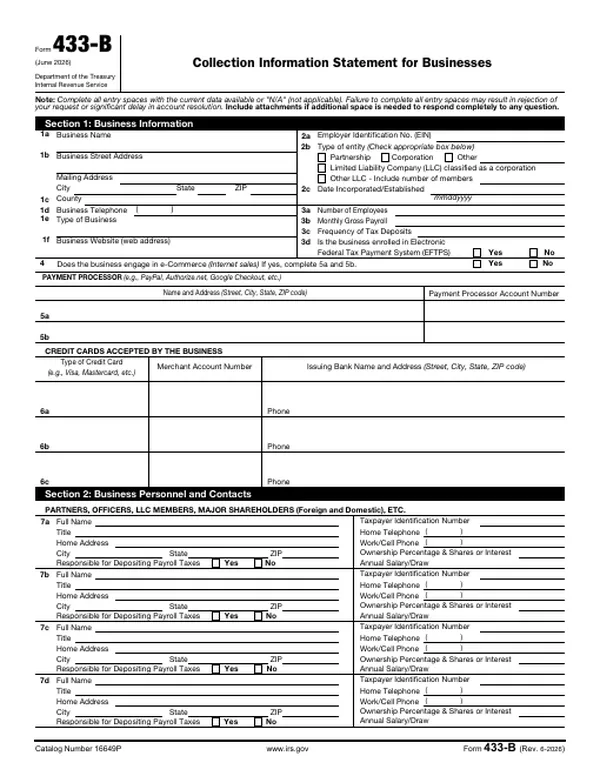
When to use Form 433-B
Form 433-B is used when the liable taxpayer is a business entity: a corporation, a partnership, an LLC taxed as a corporation or partnership, or another entity that is not a sole proprietorship. A sole proprietor's business figures go in Sections 6 and 7 of Form 433-A instead; line 52 of 433-A sends any business that is not a Schedule C sole proprietorship to 433-B.
Some cases need both forms. IRM 5.15.1.2 explains that cases on partnerships and single-member LLCs where the individual owner is the liable taxpayer require analysis of the business income and expenses reported on Form 433-B and the owner's income and living expenses on Form 433-A. A business that owes employment taxes also tends to trigger a parallel look at responsible persons for the trust fund recovery penalty, and the officers may be asked for their own 433-A.
For an offer in compromise, use Form 433-B (OIC) from the Form 656-B booklet, not this form. The booklet's Step 3 says to fill out 433-B (OIC) “if the business is a Corporation, Partnership, or LLC.”
Line by line
The note at the top of the form sets the standard: “Failure to complete all entry spaces may result in rejection of your request or significant delay in account resolution.” Enter current data or N/A in every space.
- Sec. 1Business Information (lines 1a to 6c)
- Business name, street and mailing address, county, phone, type of business and website (1a to 1f); EIN, type of entity (partnership, corporation, LLC classified as a corporation, other LLC with number of members, other) and date incorporated or established (2a to 2c); number of employees, monthly gross payroll, frequency of tax deposits and EFTPS enrollment (3a to 3d); whether the business sells online (4); payment processors such as PayPal with account numbers (5a, 5b); and credit cards accepted, with merchant account numbers and issuing banks (6a to 6c).
- Sec. 2Business Personnel and Contacts (lines 7a to 7d)
- Partners, officers, LLC members and major shareholders, foreign and domestic: name, TIN, title, home address and phones, ownership percentage and shares or interest, annual salary or draw, and a yes or no box for whether the person is responsible for depositing payroll taxes.
- Sec. 3Other Financial Information (lines 8 to 15)
- Payroll service provider or reporting agent (8), lawsuits (9), bankruptcy (10), amounts owed to the business by related parties such as officers or partners (11), assets transferred for less than full value in the last 10 years (12), affiliations such as parent or subsidiary companies (13), anticipated changes in income (14), and whether the business is a federal government contractor (15).
- Sec. 4Business Asset and Liability Information (lines 16a to 25c)
- Cash on hand and whether there is a safe on the premises (16a, 16b); business bank accounts including online accounts (17, total 17d); accounts and notes receivable including e-payment receivables, factoring and government contracts (18, total 18f); investments (19c); digital assets, with who has access to private keys (20a to 20e); available credit (21); real property (22e); vehicles (23e); equipment, inventory and intangible assets (24a to 24h); and business liabilities such as notes and judgments not listed elsewhere (25a to 25c).
- Sec. 5Monthly Income/Expenses Statement for Business (lines 26 to 50)
- Gross receipts, rental income, interest, dividends, cash receipts and other income (26 to 35, total 36); materials, inventory, wages, rent, supplies, utilities, vehicle costs, repairs, insurance, current taxes and other expenses (37 to 47); line 48 is IRS use only for allowable installment payments; total expenses (49) and net income (50). Footnotes define materials, inventory, supplies, utilities and current taxes.
- SignCertification
- Signed under penalties of perjury with the signer's title and date. Use someone with authority over the business's finances: an officer, general partner or managing member.
Section 5 is a cash statement. The current taxes footnote includes the employer's portion of employment taxes, and the IRM excludes non-cash items: IRM 5.15.1.2 states “Non-cash expenses such as depreciation are not an allowable business expense when determining the taxpayer's payment potential.” The same paragraph says excessive officer compensation should be reduced and added back to business income.
Where and how to submit it
As with 433-A, there is no filing address. The completed form and attachments go to the revenue officer or IRS office that asked for it. A business taxpayer's own financial statements can help: IRM 5.15.1.2 says “A business taxpayer's own financial statement (income statement and balance sheet) can be used as a substitute for the income and expense section of the Collection Information Statement.” The asset and personnel sections still need to be completed.
- Confirm the entity, EIN and periods in collection, and that a current Form 2848 is on file for the business.
- Pull the general ledger, the last three to six months of bank and merchant processor statements, an aged receivables list, loan statements and a fixed asset list.
- Complete every line or enter N/A; reconcile Section 5 to the books and the bank deposits.
- Have an authorized officer or partner sign and date with title.
- Deliver by the revenue officer's deadline and keep a complete copy.
What the IRS does with it
For businesses, the IRM expects the revenue officer to see the operation. IRM 5.15.1.4 says that unless a safety concern has been identified, an appointment to visit a BMF taxpayer “must be made to observe and document the physical layout of the business, number of employees, and the type and condition of the business assets.” When a representative handles the case, IRM 5.15.1.2 has the revenue officer schedule an appointment to meet the representative at the business to view its assets.
The analysis follows IRM 5.15.1.3: identify liquid assets and equity that can pay the liability, assets that can be pledged (the IRM gives “equipment or accounts receivable that may be factored” as examples), lines of credit, and the ability to borrow. The Collection Financial Standards do not apply to businesses: IRM 5.15.1.2 says the allowable living expense standards “are not applicable to corporations, partnerships, Limited Liability Companies (LLC), or for any business expenses.” Business expenses are allowed if they are necessary to produce the income.
A business that keeps accruing new liabilities while the statement is being analyzed is treated differently. IRM 5.15.1.2 says enforced collection should be considered for a business that continually fails to make current deposits, pointing to the in-business repeater procedures. Being current on deposits for the current quarter is also an eligibility condition for an offer in compromise.
Receivables and government contracts on line 18 are levy sources. Expect the revenue officer to ask for customer names and amounts, and remember the certification is signed under penalties of perjury.
Common problems
- Owners and officers left off line 7, or the payroll tax box left blank. Line 7 asks who is responsible for depositing payroll taxes, which is the starting point for trust fund recovery penalty interviews.
- Depreciation or owner draws in expenses. Non-cash expenses are not allowed, and payments to owners are evaluated separately.
- Receivables understated. An aged receivables report that does not match line 18 undermines the whole statement.
- Payment processors and merchant accounts omitted on lines 5 and 6. PayPal, card processors and similar accounts are listed separately and are easy to verify.
- Transfers for less than full value on line 12 not disclosed. These can support nominee or transferee theories later.
- Not current on deposits. A business that is pyramiding employment taxes while asking for an installment agreement is likely to see enforcement rather than an agreement.
Questions practitioners ask
Does a single-member LLC file Form 433-A or 433-B?
It depends on who is liable for the tax at issue. If the LLC itself is the liable taxpayer, the business analysis is on Form 433-B. If the individual owner is the liable taxpayer, IRM 5.15.1.2 requires both the business figures on 433-B and the owner's living expenses on 433-A.
Can I attach the company's financial statements instead of completing Section 5?
Yes for the income and expense section. IRM 5.15.1.2 allows a business taxpayer's own income statement and balance sheet to substitute for that section, but the remaining sections still need to be completed.
Will the revenue officer visit the business?
Generally yes. IRM 5.15.1.4 says an appointment to visit a BMF taxpayer must be made to observe the business unless a safety concern has been identified.
Is Form 433-B used for an offer in compromise?
No. Use Form 433-B (OIC), Rev. April 2026, from the Form 656-B booklet, which computes the business's minimum offer amount.
Do the Collection Financial Standards cap business expenses?
No. IRM 5.15.1.2 says the allowable living expense standards do not apply to corporations, partnerships, LLCs or any business expenses. Business expenses must be necessary to produce income; depreciation is not allowed and excessive officer compensation can be added back.