When to use Form 843, and when another form is right
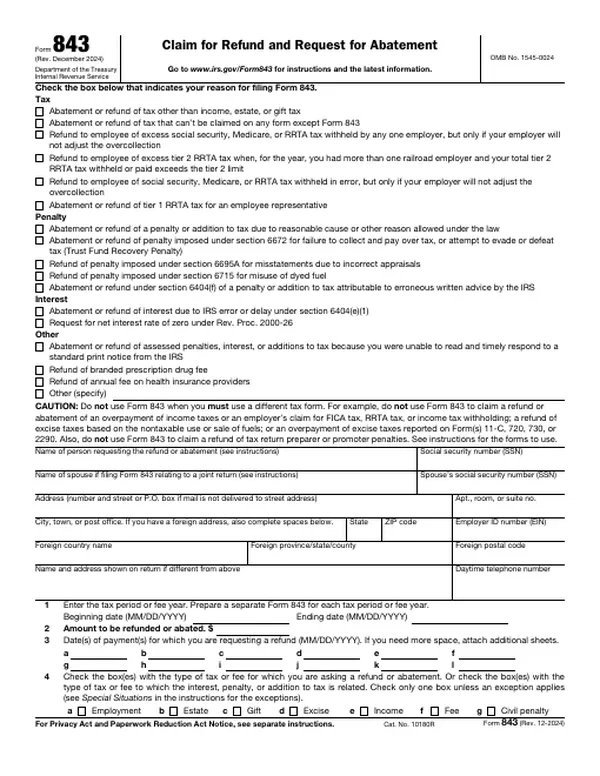
The redesigned form starts with a block of checkboxes for the reason for filing, grouped as Tax, Penalty, Interest and Other. The main practitioner uses are:
- Abatement or refund of a penalty or addition to tax for reasonable cause or another reason allowed by law, including First Time Abate.
- Abatement under IRC 6404(f) for erroneous written IRS advice.
- Abatement of interest for IRS error or delay under IRC 6404(e)(1), covered on interest abatement.
- A request for the net interest rate of zero under Rev. Proc. 2000-26.
- Abatement or refund of the trust fund recovery penalty. For a refund claim the instructions require payment of the portion attributable to one employee (or one transaction for excise TFRP). The divisible payment, claim and bond procedure of IRC 6672(c) is covered under the statutes behind the form.
- An employee's refund of excess Social Security, Medicare or RRTA tax withheld by one employer that will not adjust it.
The caution on the form lists what does not go on Form 843. The instructions are direct: “Do not use Form 843 to request an abatement of income, estate, or gift tax.” Income tax refunds go on Form 1040-X or 1120-X. Employers correct FICA, RRTA and withholding on the matching X form (941-X, 943-X, 944-X, 945-X, CT-1 X). Fuel credits use Form 4136 or 8849, preparer and promoter penalty refunds use Form 6118, and injured spouse claims use Form 8379. User fees are excluded too: “Do not use Form 843 to claim a refund of agreement fees, offer-in-compromise fees, or lien fees.”
Form 843 is often not the fastest route. The instructions tip says that if an IRS notice told the client about a penalty, follow the notice and Form 843 may not be needed. Many FTA requests are granted by phone or letter; see phone, letter or Form 843. Form 843 matters most for paid penalties, where it is the formal refund claim that protects the statute (see refund claims for paid penalties).
Line by line
- TopReason checkboxes, name, TIN, address
- Check one reason box only. Enter the name of the person requesting the refund or abatement; for a joint return, add the spouse and both SSNs. Entities enter the EIN. Add the name and address shown on the return if different.
- Line 1Tax period or fee year
- Beginning and ending dates. Prepare a separate Form 843 for each period. Leave blank for a net-zero interest request. For the branded prescription drug fee, enter the fee year as the beginning date.
- Line 2Amount to be refunded or abated
- The dollar amount. Optional on a net-zero interest request.
- Line 3Date(s) of payment(s)
- For a refund, the date of each payment. This line is what ties a penalty refund to the lookback period, so list every payment that included the penalty.
- Line 4Type of tax or fee
- Employment, estate, gift, excise, income, fee or civil penalty. For a penalty or interest request, check the type of tax the penalty relates to. Check one box unless a special situation (net-zero interest, multi-year 6404(e) error) allows more.
- Line 5Type of return or fee
- 706, 709, 940, 941, 943, 944, 945, 990-PF, 1040 (covers 1040-SR, 1040-NR), 1120, 4720, CT-2, BPD fee, or other.
- Line 6Internal Revenue Code section
- For a penalty, the Code section, usually shown on the notice of assessment (for example 6651(a)(1) or 6656).
- Line 7Reason for the request
- (a) interest from IRS errors or delays, (b) erroneous written IRS advice, (c) reasonable cause or other reason allowed under the law, (d) none of the above.
- Line 8Explanation and computation
- The facts and how the line 2 amount was computed, with supporting documents. Put the name and TIN on every attachment. For 6404(e), state the type of tax, when the IRS first notified the client in writing, the period of interest, the circumstances and why not abating would be grossly unfair. For 6404(f), attach the written request for advice, the advice, and any report showing the penalty.
- SignatureTaxpayer, spouse, preparer
- Both spouses sign for a joint return; a corporate officer signs with title; a fiduciary signs for an estate or trust. A paid preparer signs the preparer block. If a representative files it, attach Form 2848 with authority for the request; a legal representative of a decedent attaches proof of authority and Form 1310.
Where and how to file
| If the Form 843 is | Mail it to (from the instructions) |
|---|---|
| In response to an IRS notice | The return address on the notice |
| A refund claim on a Form 706 or 709 matter | Internal Revenue Service, Attn: E&G, Stop 824G, 7940 Kentucky Drive, Florence, KY 41042-2915 |
| A net interest rate of zero request | The service center where the most recent return was filed |
| A Form 8300 matter | Internal Revenue Service, Rosa Parks Federal Building, P.O. Box 32621, Detroit, MI 48232 |
| Branded prescription drug fee (Letter 4658) | Internal Revenue Service, Mail Stop 4921 BPDF, 1973 N. Rulon White Blvd., Ogden, UT 84201-0051 |
| A penalty or anything else | The service center where a current year return for that tax would be filed |
There is no e-file or online submission route for Form 843 in the instructions. Mail with proof of mailing. On timing, the instructions state: “Generally, you must file a claim for a credit or refund within 3 years from the date you filed your original return or 2 years from the date you paid the tax, whichever is later.” A 6404(f) request is allowed if made within the collection period for the penalty, or if the penalty was paid within the refund period.
The statutes behind the form
Form 843 is a claim, and four Code sections decide what it can recover and what happens after the IRS answers it.
| Provision | What it does for a Form 843 filer |
|---|---|
| IRC 6511(a) and (b)(2), claim deadline and lookback cap | The 3-year-from-filing or 2-year-from-payment deadline is only half the rule. Even a timely claim is capped by the lookback: when the claim is filed within the 3-year period, the refund “shall not exceed the portion of the tax paid within the period, immediately preceding the filing of the claim, equal to 3 years plus the period of any extension of time for filing the return”; when it is not, the cap is the tax paid in the 2 years before the claim. Line 3 payment dates are what the IRS uses to apply this, which is why they matter for a penalty paid in installments. |
| IRC 6532(a), time to sue | No refund suit may begin until 6 months after the claim is filed unless the IRS decides sooner, “nor after the expiration of 2 years from the date of mailing by certified mail or registered mail by the Secretary to the taxpayer of a notice of the disallowance”. The notice is Letter 105C for a full disallowance or Letter 106C for a partial one (IRM 21.5.3.4.6.1). The 2 years can be extended by written agreement; IRM 21.5.3.4.6.2 says “The IRS uses Form 907, Agreement to Extend the Time to Bring Suit, to extend this time period.” A request for reconsideration or an Appeals review after the letter does not stop the clock (IRC 6532(a)(4)), and a signed Form 2297 waiver of the notice starts the 2 years on the day it is filed. See refund suits and claims. |
| IRC 6672(c), trust fund recovery penalty | Within 30 days after notice and demand for the penalty, the responsible person can pay the divisible portion (the instructions say the part attributable to one employee, or one transaction for excise TFRP), file the Form 843 claim for that amount, and post a bond of one and a half times the unpaid balance. Collection of the rest by levy or suit then stops until the refund suit is resolved, provided the suit is filed in district court or the Court of Federal Claims within 30 days after the claim is denied. Without the bond, the IRS can keep collecting while the claim is pending. See trust fund recovery penalty. |
| IRC 6404(h), interest abatement in Tax Court | A denied 6404(e) claim is the one Form 843 outcome with Tax Court review. A taxpayer who meets the net worth limits of IRC 7430(c)(4)(A)(ii) may petition after the earlier of the mailing of the IRS final determination or 180 days after the claim was filed, and no later than 180 days after that final determination; the court decides whether the refusal was an abuse of discretion. IRM 21.5.3.4.6.1 sets the letter sequence: Letter 3010C or 3022C with Appeals rights first, then Letter 3180C or 3181C by certified mail as the final determination that starts the 180 days. See interest abatement. |
What the IRS does with it
IRM 20.1.1 governs penalty relief requests, whichever form they arrive on. The IRM treats Form 843 as a formal claim: its glossary defines a formal claim as a request on the proper form, such as Form 843, 1040-X or 1120-X, asking that a liability previously assessed be reduced.
The employee first corrects the account. IRM 20.1.1.3 requires that missing payments, extensions and tax adjustments be resolved before relief is weighed: “Do not consider penalty relief until all issues have been addressed.” Relief is then considered in a fixed order: correction of IRS error, statutory and regulatory exceptions, administrative waivers such as FTA, and reasonable cause.
A signed written request matters for anything beyond the routine. Under IRM 20.1.1.3.1, oral or unsigned requests can be considered only for failure-to-file, failure-to-pay and failure-to-deposit penalties within thresholds the public IRM redacts. For other penalties, including TIN and information return penalties and penalties assessed by a compliance program, the taxpayer must provide a written statement signed under penalty of perjury. Form 843 satisfies that.
For erroneous advice, the form is preferred but not required. IRM 20.1.1.3.3.4: “However, if Form 843 is not filed and the information provided demonstrates that abatement of the penalty is warranted, the penalty should be abated, whether or not a Form 843 is provided.”
If the request is denied, the taxpayer can ask for a manager's conference or Appeals. IRM 20.1.1.4.1: “Appeals will only review a penalty if the request for relief has been previously denied by an IRS employee and the taxpayer requests an appeal.” Appeals can settle penalties on hazards of litigation. See appealing a penalty abatement denial. A claim that is disallowed, or not acted on, also opens the refund suit route described on refund suits and claims.
Common rejections and mistakes
- Using Form 843 for income tax. The IRS will not treat it as the right vehicle. Use the amended return.
- More than one reason box or more than one period on a single form, outside the exceptions.
- No payment dates on line 3 for a refund, which leaves the lookback period unclear.
- No Code section on line 6 when the notice shows it.
- A thin line 8. The explanation is the claim. Facts, dates and documents decide reasonable cause.
- Representative files without Form 2848 attached, or the 2848 does not cover the period or penalty.
- Waiting too long. A penalty paid more than 2 years ago on a return filed more than 3 years ago is usually outside the refund period.
- Interest abatement for the wrong tax. The instructions say 6404(e) interest abatement applies only to taxes for which a notice of deficiency is required; interest on employment taxes and most excise taxes cannot be abated this way.
Templates: reasonable cause letter and First Time Abate request letter, which can be attached as the line 8 statement. For payers with information return penalties, TIN Comply's reference covers Form 843 claim vs abatement and a penalty refund claim template.
Transition to Automatic Exemption from Penalty. The IRS First Time Abate page (reviewed October 2026) says FTA “is transitioning to a new relief called Automatic Exemption from Penalty (AEP), starting Summer 2026”. For Forms 1040, 1065 and 1120, Forms 940 through 945 and Form CT-1, beginning with 2025 tax year returns and 2026 quarterly returns, AEP is applied when the original return completes processing: with three prior years (or 12 consecutive quarters) of timely filing and payment, “The IRS won’t assess penalties for failure to file, failure to pay, or failure to make a deposit” and sends a letter saying the relief was applied; “You don’t need to contact the IRS or respond to the notice.” FTA continues to apply to earlier periods and to returns AEP does not cover, and the page says to contact the IRS if a penalty was assessed that should have qualified. See First Time Abate.
Questions practitioners ask
Do I need Form 843 to request First Time Abate?
No. The IRM allows FTA to be considered on oral and written requests, and many are granted by phone. Form 843 is useful when the penalty is already paid, when a phone request was denied, or when a signed record of the request is needed to protect the refund statute.
Can one Form 843 cover several years?
Generally no; the instructions require a separate form for each tax period or fee year and type of tax. The exceptions are the net interest rate of zero request and a 6404(e) request where a single IRS error affected several years or taxes.
How long do I have to claim a refund of a paid penalty?
The instructions state the general rule: within 3 years from the date the original return was filed or 2 years from the date the tax was paid, whichever is later. Requests based on erroneous written advice have their own timing rule.
Where do I send Form 843 if the client got a penalty notice?
To the return address on the notice. Otherwise, send a penalty claim to the service center where the client would file a current year return for that tax.
Can Form 843 be used for an employer's overpaid FICA?
No. Employers use the X form that matches the original return, such as Form 941-X. An employee whose employer will not adjust over-withheld Social Security or Medicare can use Form 843 with a statement from the employer or an explanation of why one could not be obtained.
What happens if the IRS denies the Form 843?
The taxpayer can request a conference with the manager or ask for Appeals in writing. If the penalty was paid and the claim is disallowed, a refund suit in district court or the Court of Federal Claims is the judicial route, and IRC 6532(a) gives 2 years from the certified mailing of the Letter 105C or 106C to file it; an Appeals review does not extend that period unless a Form 907 is signed. A denied interest abatement claim can instead go to the Tax Court within 180 days of the final determination under IRC 6404(h).
Is a timely Form 843 always paid in full?
No. IRC 6511(b)(2) caps the refund at the tax or penalty paid within the lookback period: 3 years plus any filing extension before the claim when the claim is filed within 3 years of the return, otherwise 2 years. Payments older than that are not recoverable even if the claim itself is timely, which is why line 3 asks for every payment date.