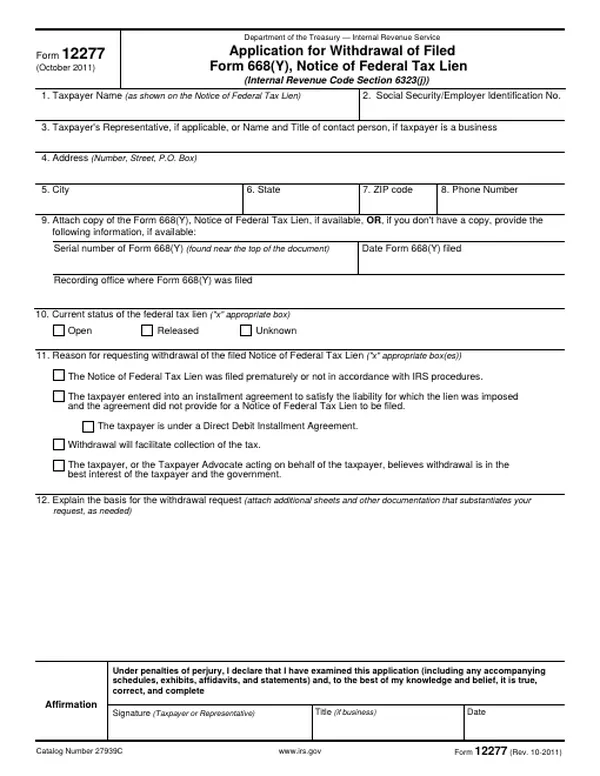
When to use Form 12277 (and when another certificate fits)
A withdrawal is different from a release. IRM 5.12.9.2: “A Withdrawal only removes the effect of the NFTL whereas the Certificate of Release both releases the NFTL (paper document) and extinguishes the statutory tax lien.” Withdrawal also abandons the NFTL's priority. Taxpayers generally request it on Form 12277, though any written request with enough information works.
It is discretionary. The same subsection says withdrawal is not mandatory except when the NFTL was filed in violation of the bankruptcy automatic stay, and that the IRS “may, but is not required to, authorize the withdrawal.”
Pick the right tool. IRM 5.12.10.2 lists four ways to deal with a lien's effect on property: discharge removes specific property (usually for a sale; see Form 14135), subordination puts another creditor ahead (usually for a refinance), non-attachment confirms the lien does not reach someone, and withdrawal removes the NFTL from the public record. The IRM's withdrawal factors ask whether “a lien subordination or discharge of certain property from the lien achieve the same result as a withdrawal”; if so, withdrawal is not appropriate. See federal tax liens: filing, withdrawal, discharge and subordination.
Line by line
- 1, 2Taxpayer Name; Social Security/Employer Identification No.
- As shown on the NFTL.
- 3Taxpayer's Representative, if applicable, or Name and Title of contact person
- The preparer or representative if different from the taxpayer; for a business, the name and title of the person applying. Attach a Form 2848 if you will discuss the request.
- 4 to 8Address, City, State, ZIP code, Phone Number
- Current contact information for the taxpayer or representative.
- 9Copy of the Form 668(Y), or serial number, filing date and recording office
- Attach the NFTL if available. Otherwise give the serial number near the top, the date filed and the recording office.
- 10Current status of the federal tax lien
- Open (balance still owed), Released (satisfied or unenforceable) or Unknown.
- 11Reason for requesting withdrawal
- Check one or more: filed prematurely or not in accordance with IRS procedures; installment agreement that did not provide for an NFTL (with a sub-box for a Direct Debit Installment Agreement); withdrawal will facilitate collection; or best interest of the taxpayer and the government. The instructions say a request to withdraw a released NFTL generally uses the best interest box.
- 12Explain the basis for the withdrawal request
- A detailed explanation with documents. This is where the request is won or lost.
- AffirmationSignature (Taxpayer or Representative), Title (if business), Date
- Signed under penalties of perjury.
The instructions add that, at the taxpayer's written request, the IRS will notify credit reporting agencies, financial institutions and creditors of the withdrawal; the request should list their names and addresses and serves as authority to disclose. IRM 5.12.9.4 lists the same authorization among the items a request must contain.
Where and how to file
The instructions say to mail the application to the IRS office assigned the account; if the account is not assigned, or you are not sure, mail it to IRS, ATTN: Advisory Group Manager, in the area where the taxpayer lives or has its principal place of business, using Publication 4235 for addresses. IRM 5.12.9.4 says a faxed request qualifies as written, and the request must be signed by the taxpayer or a valid POA (an appropriate officer for a business).
- Identify every NFTL involved (serial numbers, dates, recording offices) and whether each is open or released.
- Choose the IRC 6323(j) ground that fits and gather proof: the installment agreement terms, DDIA payment history, a lender's letter, or evidence of an IRS procedural error.
- Write the line 12 explanation tied to the IRM factors for that ground.
- List any creditors, credit bureaus and lenders to notify.
- Sign, send to the assigned revenue officer or the Advisory group, and calendar follow-up.
What the IRS does with it
The assigned Collection employee reviews it, or Advisory if the account is unassigned (IRM 5.12.9.5). Advisory opens a control within 7 days, contacts the taxpayer within 21 days if more information is needed, and generally allows up to 30 days to respond. Recommendations are generally made within 30 days of a complete request, and Advisory has 10 days to approve or deny a field recommendation. Revenue officers can decide premature-filing requests themselves; other grounds go to Advisory.
| Ground (IRC 6323(j)(1)) | What the IRM looks for |
|---|---|
| (A) Premature or not per procedures | The filing was premature or otherwise not in accordance with administrative procedures (IRM 5.12.9.3.1) |
| (B) Installment agreement | Withdrawal may be considered if the agreement did not address the NFTL or said one may be filed; generally not granted if the agreement provided for one (IRM 5.12.9.3.2) |
| (B) Direct debit IA | Unpaid assessed balance of $25,000 or less, full payment within 60 months or before the CSED, a written request, compliance, at least three consecutive direct debit payments with no defaults, and no prior withdrawal for those modules (IRM 5.12.9.3.2.1) |
| (C) Facilitates collection | Withdrawal leads to more being collected than keeping the NFTL; factors include new credit, partial payments, bankruptcy risk and compliance (IRM 5.12.9.3.3) |
| (D) Best interest | Both the taxpayer (or the National Taxpayer Advocate) and the IRS determine withdrawal is in their interest (IRM 5.12.9.3.4) |
After release, withdrawal is often granted. IRM 5.12.9.9 says a request under the best interest ground for a released lien will generally be granted if the request is written, the liabilities were fully satisfied, a certificate of release was issued, and the taxpayer is in filing compliance. “Fully satisfied” includes payment, abatement and a fully paid accepted offer, but the IRM excludes expiration of the collection statute and bankruptcy discharge.
When approved, the IRS files Form 10916(c) in the recording office and sends the taxpayer a copy, per the form instructions. When denied, IRM 5.12.9.8 says the approving office sends Letter 4711 with Pub 1660 and Form 9423, explaining the right to discuss it with the manager and to appeal. See the Collection Appeals Program and Form 9423. Withdrawal can also be raised in a CDP hearing after an NFTL filing.
A withdrawn NFTL can come back. IRM 5.12.9.3.2.1 says a new NFTL may be filed if the taxpayer defaults on the direct debit agreement or converts it to a regular agreement after withdrawal.
Common reasons requests are denied
- The installment agreement provided for the NFTL. The IRM generally denies withdrawal under (B) in that case.
- A discharge or subordination would solve the problem. The IRM treats that as a reason to deny withdrawal.
- Not in compliance with filing or deposit requirements.
- Credit-score-only reasons. One IRM example denies withdrawal where the only harm was creditworthiness under an installment agreement that required the lien.
- DDIA criteria not met: balance over $25,000, fewer than three direct debit payments, or a regular agreement not converted.
- Thin line 12 explanation with no documents.
Questions practitioners ask
What is the difference between a lien release and a withdrawal?
IRM 5.12.9.2 says a withdrawal only removes the effect of the NFTL, while a certificate of release releases the NFTL and extinguishes the statutory lien. A withdrawal can be requested after a release to remove the notice from the public record as well.
Can I get a lien withdrawn just by setting up a direct debit installment agreement?
Possibly. IRM 5.12.9.3.2.1 generally supports withdrawal when the assessed balance is $25,000 or less, the agreement will pay in full within 60 months or before the CSED, at least three consecutive direct debit payments have been made, and the taxpayer is compliant and asks in writing.
Will the IRS notify credit bureaus?
If asked in writing. The Form 12277 instructions say the IRS will notify the credit reporting agencies, financial institutions and creditors you list.
Can a denial be appealed?
Yes. IRM 5.12.9.8 says the denial letter (Letter 4711) explains appeal rights and includes Pub 1660 and Form 9423 for the Collection Appeals Program.
Can a lien be withdrawn after the collection statute expired?
Not under the post-release rule: IRM 5.12.9.9 excludes CSED expiration and bankruptcy discharge from fully satisfied. A request based on improper filing under IRC 6323(j)(1)(A) is a separate route.