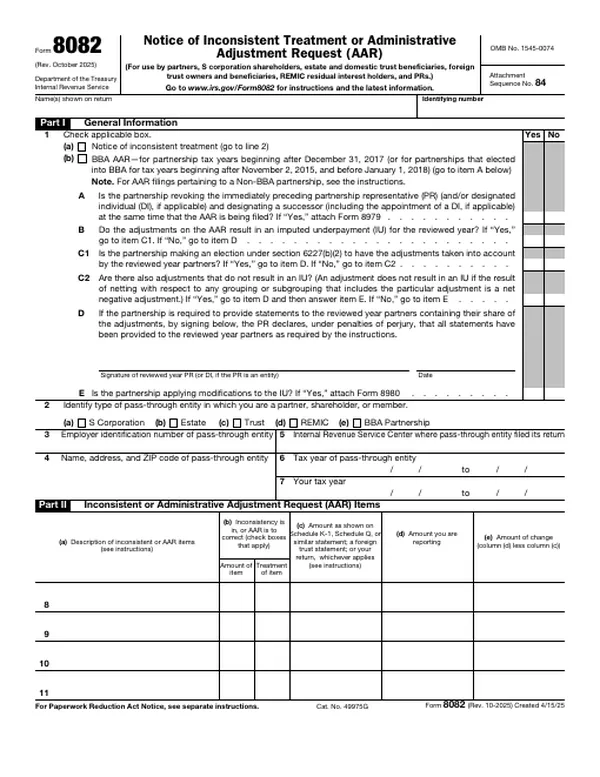
When to use Form 8082 (and when another route is right)
Notice of inconsistent treatment. Partners in BBA partnerships, S corporation shareholders, estate and trust beneficiaries, foreign trust owners and REMIC residual holders must generally report items the way the entity reported them. The instructions say Form 8082 is used “to notify the IRS of any inconsistency between your tax treatment of an item and the way the pass-through entity treated and reported the same item on its return,” and also when a Schedule K-1, Schedule K-3, Schedule Q or foreign trust statement was not received by the return due date. The caution that matters: without the notice, a deficiency to conform the item to the entity's return “may be assessed immediately.”
BBA AAR. A BBA partnership that wants to correct a filed Form 1065 cannot simply amend it and issue amended K-1s. The instructions describe Form 8082 for the PR or DI “requesting an administrative adjustment on behalf of the BBA partnership to correct a previously filed partnership return.” See administrative adjustment requests and amended return or AAR.
The instructions list who may not use the form, including:
- A partner whose partnership received a BBA audit adjustment on Form 8986: “A partner is bound to finally determined adjustments on Form 8986 resulting from a BBA partnership audit and may not use Form 8082 to report the items differently.”
- Partners of a partnership that elected out of BBA under IRC 6221(b) (see electing out).
- A BBA partnership filing only to change its PR; use Form 8979.
- A BBA partnership after a notice of administrative proceeding has been mailed, and its partners for inconsistent treatment of that partnership's items.
- S corporation shareholders and estate or trust beneficiaries correcting entity items on their own returns; they file amended returns, using 8082 only as an inconsistency notice.
Line by line
- HeaderName(s) shown on return; Identifying number
- The filer's legal name and TIN: the partner for a notice of inconsistent treatment, the partnership for an AAR.
- 1(a)Notice of inconsistent treatment
- Check to report an item inconsistently or to report a missing K-1, K-3, Schedule Q or foreign trust statement, then go to line 2.
- 1(b)BBA AAR
- Check for an AAR by a BBA partnership (tax years beginning after December 31, 2017, or earlier years that elected into BBA). Then answer items A to E.
- ARevoking the PR and designating a successor
- Yes if a new PR (and DI) is being designated with the AAR; attach Form 8979.
- BDo the adjustments result in an imputed underpayment (IU)?
- The instructions require an IU computation on every BBA AAR, even when the result is zero or negative. Yes goes to C1; No goes to D.
- C1Election under section 6227(b)(2)
- Yes if the partnership elects to have the reviewed year partners take the adjustments into account instead of paying the IU (a push-out). If the election is invalid, the partnership remains liable for the IU.
- C2Adjustments that do not result in an IU
- Yes if, in addition to an IU, some adjustments net to a negative amount; those must be pushed out on Forms 8986 even though the IU is paid.
- DPR declaration and signature
- When statements must go to reviewed year partners, the PR (or DI) signs under penalties of perjury that all Forms 8986 have been provided. The instructions say the PR will manually sign here.
- EModifications to the IU
- Yes if the partnership is applying permitted modifications; attach Form 8980. Modifications are disregarded if a valid push-out election is made.
- 2 to 7Pass-through entity information
- Type of entity, its EIN, name and address, the IRS center where it filed, its tax year and yours. For a notice relating to a Form 8986 from a BBA AAR, line 6 uses the entity year that includes the date in Form 8986, Part II, item D.
- 8 to 11Inconsistent or AAR items, columns (a) to (e)
- Only needed when an amount or treatment of a monetary item changes. (a) item description or K-1 line; (b) whether the amount, the treatment, or both are inconsistent or being changed; (c) the amount as reported (zero if no schedule was received); (d) the amount you are reporting; (e) the change, column (d) less column (c), with negatives in parentheses.
- Part IIIExplanations
- Enter the Part II line number before each explanation. For an AAR, show how the IU was calculated and how modifications were applied. Missing-schedule cases use the stock explanations given in the instructions.
An AAR that results in a positive IU must be paid when filed unless the partnership makes the push-out election. The instructions say that if the partnership does not elect, it “must report and pay the IU and any interest and penalty associated with the IU at the time the AAR is submitted.” Use the imputed underpayment estimator to frame the computation.
Where and how to file
Form 8082 is never filed by itself. A notice of inconsistent treatment is attached to the partner's original or amended return. An AAR is filed by the partnership in the same manner as its original return:
- E-filed AAR: IRM 4.31.9.7.7.1 says the partnership uses Form 1065, marks the amended return box, and attaches Form 8082 with the BBA AAR box checked. The instructions say “Form 8082 should be attached as a PDF to Form 1065.” The IRS AAR filing page adds that when adjustments are pushed out, the PR (or DI) manually signs item D and “a copy of this signature page filed with the 1065 as a PDF attachment.” Neither source describes an XML schema version of Form 8082 for the AAR, so plan on the PDF attachment.
- Paper AAR: the partnership uses Form 1065-X, marks the BBA AAR box and completes the applicable sections (IRM 4.31.9.7.7.1).
- Attach the IU computation and supporting schedule, Form 8980 if modifications are applied, Forms 8985 and 8986 if any adjustments are pushed out, Form 8979 if the PR is changing, and Form 8302 for a direct-deposited refund of $1 million or more.
- Do not include amended Schedules K-1 or K-3; partners receive Forms 8986 instead.
- Pay any IU, penalties and interest with the AAR; the instructions direct electronic payments to the payment type BBA AAR Imputed Underpayment.
- Furnish Forms 8986 to reviewed year partners on the day the AAR is filed, and keep proof for the item D declaration. Reg. 301.6227-1(d): “The statement must be furnished to the reviewed year partner on the date the AAR is filed with the IRS.” The IRS AAR filing page repeats that the Forms 8986 “must also be furnished to the partners on the date the AAR is filed with the IRS.”
Timing: under IRC 6227(c) a partnership may not file an AAR more than 3 years after the later of the date its return was filed or “the last day for filing the partnership return for such year (determined without regard to extensions),” and never after a notice of administrative proceeding has been mailed. Reg. 301.6227-1(b) adds that an AAR can only be filed after the return for that year has been filed. IRM 4.31.9.7.7.1 repeats the 3-year and NAP limits. An extended Form 1065 therefore does not buy extra AAR time: the clock runs from the actual filing date or the unextended due date, whichever is later.
What the IRS does with it
A valid AAR changes the partnership adjustment statute. IRM 4.31.9.7.7 states “The filing of a valid AAR will extend the IRC 6235(a)(1) statute date to the date which is 3 years from the date the AAR was filed.” See the BBA adjustment period.
During an exam, examiners do not take an AAR across the desk. IRM 4.31.9.7.7: “An examiner MUST NOT accept an AAR (or any other subsequent filing) directly from the PR or POA.” The PR is directed to file through official channels, and the examiner makes a mandatory referral to a BBA point of contact to decide whether the filing is a valid AAR, whether it was timely, and how the statute is updated.
On the partner side, the IRM confirms the push-out mechanics: if reviewed year partners must take adjustments into account, the partnership files Forms 8985 and 8986 with the AAR, and a pass-through partner either furnishes its own Forms 8986 or pays an IU by the extended due date of the AAR partnership's adjustment year return (IRM 4.31.9.7.7.1). For audits, see the BBA exam process.
Interest. Who pays interest, and from when, depends on whether the partnership pays the IU or pushes the adjustments out:
| Route | Who owes interest | Period and rate | Source |
|---|---|---|---|
| Partnership pays the IU with the AAR | The partnership | The Form 8082 instructions describe interest “for the period beginning on the day after the return due date for the reviewed year and ending on the return due date for the adjustment year” (as defined in IRC 6225(d)(2)) or, if earlier, the date the IU is paid. Penalties are applied as if the partnership were an individual and the IU an actual underpayment | Instructions for Form 8082 (Rev. 10-2025); IRC 6227(b)(1) |
| Push-out election, or adjustments that do not result in an IU | Each reviewed year partner, on its own additional reporting year tax | Determined at the partner level, from the due date of the partner's return for the year to which the increase is attributable until paid, at the IRC 6621(a)(2) underpayment rate. The 2-point increase that applies to audit push-outs under IRC 6226(c)(2)(C) does not apply: IRC 6227(b)(2) applies section 6226 “determined without regard to the substitution described in subsection (c)(2)(C) thereof,” and Reg. 301.6227-3(b)(1) says the increased-rate rule of Reg. 301.6226-3(c)(3) “does not apply” | IRC 6227(b)(2); Reg. 301.6227-3(b)(1); Instructions for Form 8082 |
What partners do with an AAR Form 8986
A partner who receives a Form 8986 from an AAR push-out does not amend the reviewed year return. Reg. 301.6227-3(a) requires each reviewed year partner to take the adjustments into account “in the reviewed year partner's taxable year that includes the date the statement is furnished (reporting year),” and Reg. 301.6227-3(b)(1) says the partner “must report and pay the additional reporting year tax” on or before the due date for the reporting year. The computation is done on Form 8978, Partner's Additional Reporting Year Tax, which the Form 8978 instructions say must be filed “with a federal income tax return for the partner's reporting year.” The reporting year is the partner's tax year that includes the date in Form 8986, Part II, item G, which for an AAR is the date the AAR was filed (see Form 8986 and Forms 8985 and 8986).
- Separate Form 8978 for AAR adjustments. The instructions require AAR-related adjustments to be separated from BBA audit adjustments: each source goes on its own Form 8978 and Schedule A, with the “AAR Filing” box checked for the AAR set and the EIN of the entity that issued the Form 8986 entered.
- Negative amounts reduce current tax. Under Reg. 301.6227-3(b)(1) a partner “may, in accordance with § 301.6226-3(a), reduce chapter 1 tax for the reporting year where the additional reporting year tax is less than zero,” and the regulation's Example 2 shows a partner claiming a refund when the reduction exceeds that year's tax. A partnership-partner, however, may not claim a refund for its share.
- Income tax only. The Form 8978 instructions say “Form 8978 should only be used for changes to a partner's income tax.” Related non-income changes such as self-employment tax go on an amended return for the partner's first affected year, with a statement explaining the computation.
- Pass-through partners that receive an AAR Form 8986 either push the adjustments further out with their own Forms 8985 and 8986 or compute and pay an IU, by the extended due date of the AAR partnership's adjustment year return (Reg. 301.6227-3(c); IRM 4.31.9.7.7.1). A pass-through partner that pays an IU “may not apply any modifications to the amount of imputed underpayment.”
- Stopping interest early. The IRS AAR filing page says an individual partner “may pay in advance to stop the running of interest,” using the payment type Prepayment on BBA AAR/Exam Push Out. Our push-out statement checklist and the push-out election page cover the partner-side timeline.
Common mistakes
- Amended K-1s with a BBA AAR. The instructions say Schedules K-1 should not be included; use Forms 8986.
- No IU computation because the result is zero or negative. The computation is always required.
- Filing after a NAP or past the 3-year window.
- AAR filed only to change the PR. Not allowed; file Form 8979 with an AAR that has another purpose, or with the examiner.
- Partner notices on audit adjustments. Partners cannot file 8082 against finally determined Form 8986 audit adjustments.
- Modifications used that AARs do not allow. Pub 5346 says amended return, alternative procedure and closing agreement modifications are not permitted in an AAR.
Questions practitioners ask
Can a partner file Form 8082 to disagree with a Form 8986 from a BBA audit?
No. The instructions say a partner is bound to finally determined audit adjustments on Form 8986 and may not use Form 8082 to report them differently. Inconsistent treatment is available for K-1s, K-3s and Forms 8986 issued with an AAR.
Who signs a BBA AAR?
The PR, or the DI if the PR is an entity. IRM 4.31.9.7.7.1 says only the PR (or DI) may sign and file an AAR on the partnership's behalf, and the PR manually signs item D when statements go to partners.
Does the partnership have to pay the imputed underpayment with the AAR?
Generally yes, unless it makes the IRC 6227(b)(2) election to push out the adjustments. Adjustments that do not result in an IU must be pushed out regardless.
Can an AAR be filed during an audit?
Not after the IRS mails a notice of administrative proceeding (with a narrow foreign tax redetermination exception noted in IRM 4.31.9.7.7.1).
How many items fit on one Form 8082?
Four monetary items (lines 8 to 11). The instructions say to use additional Forms 8082 for more items from the same entity, and a separate form for each entity.
Does a partner amend its return after receiving a Form 8986 from an AAR?
No. Reg. 301.6227-3 has the partner take the adjustments into account in the reporting year, the year that includes the date the Form 8986 was furnished, by filing Form 8978 with that year's return. Interest runs at the partner level at the regular underpayment rate; the 2-point increase for audit push-outs does not apply to AARs (IRC 6227(b)(2)). An amended return is used only for related non-income taxes such as self-employment tax.