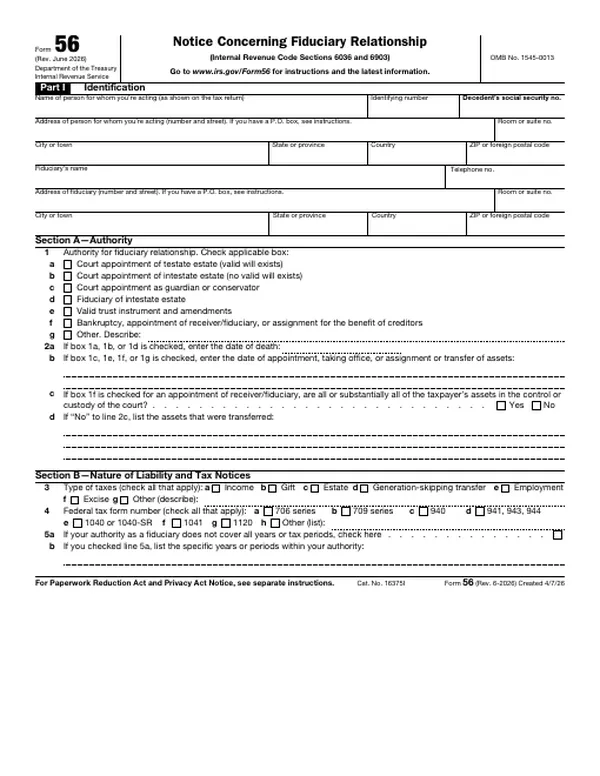
When to use Form 56, and when a power of attorney is right
The instructions draw the line between a fiduciary and a representative. “A fiduciary is treated by the IRS as if the fiduciary is actually the taxpayer.” On appointment, the fiduciary has the right and the duty to do everything the taxpayer must do, including filing returns and paying tax. A representative under Form 2848 is only an agent and can do only what the taxpayer authorized. The instructions say not to use Form 56 to tell the IRS you are a taxpayer's authorized representative.
Fiduciaries include administrators, conservators, executors, guardians, receivers, trustees of a trust, trustees in bankruptcy, personal representatives, persons in possession of a decedent's property, and debtors in possession. A fiduciary who seeks to act for a taxpayer before the IRS, or to tell the IRS that the role has ended, files Form 56. Receivers and assignees for the benefit of creditors also give notice of qualification under IRC 6036; bankruptcy trustees and debtors in possession do not, because the Bankruptcy Rules govern their notice.
Death is the common trigger. IRM 5.5.1.7 tells collection employees: “A third party authorization (Form 2848, Power of Attorney and Declaration of Representative, Form 8821, Tax Information Authorization) expires with the death of the taxpayer. Do not assume the surviving spouse is the executor for the deceased spouse.” Once a Form 56 is on file, the fiduciary can sign the decedent's final return and a Form 872, and can sign a new Form 2848 naming a practitioner. See Form 56 and representing a deceased taxpayer or estate.
Form 56 does not change an address; the instructions direct fiduciaries to Form 8822 or 8822-B for the last known address. It also cannot be used to get copies of notices. A terminating entity can only establish a fiduciary relationship while it still exists, so the instructions suggest doing it before dissolution if someone will need to handle the entity's tax matters afterward. For entity wind-downs, see closing a business with the IRS.
Line by line
- Part IIdentification
- Name of the person for whom the fiduciary acts (as on the return), identifying number, decedent's SSN, address, and the fiduciary's name, address and phone. One Form 56 per person: an executor filing the decedent's final Form 1040 and the estate's returns files one form naming the decedent and another naming the estate. An individual's number is the SSN or ITIN; any other person uses the EIN. For an estate filing Form 706, enter the decedent's SSN or ITIN and the estate's EIN if it has one. If there are several fiduciaries, each files separately.
- 1aCourt appointment of testate estate
- Executor of a decedent who left a valid will, appointed by a court. Attach current letters testamentary or a court certificate. Enter the date of death on 2a.
- 1bCourt appointment of intestate estate
- Court-appointed administrator where there was no will. Attach the court documents. Date of death on 2a.
- 1cCourt appointment as guardian or conservator
- Date of appointment on 2b.
- 1dFiduciary of intestate estate
- No will and no court appointment; check only if you are the sole person in charge of the decedent's property. Date of death on 2a.
- 1eValid trust instrument and amendments
- Trustee named under a valid instrument. Date of appointment or transfer of assets on 2b.
- 1fBankruptcy, appointment of receiver/fiduciary, or assignment for the benefit of creditors
- Bankruptcy trustee, assignee, or court-appointed receiver or fiduciary. Date assets were assigned or appointed on 2b. Receivers answer 2c (are all or substantially all assets in the court's custody?) and, if no, list the transferred assets on 2d. Lines 2c and 2d are new in the June 2026 revision.
- 1gOther
- Describe the authority. Date on 2b. The instructions warn that a fiduciary must be prepared to furnish evidence of authority.
- 3-4Type of taxes and federal tax form numbers
- Income, gift, estate, GST, employment, excise, other; and 706, 709, 940, 941/943/944, 1040, 1041, 1120 or other. Check the ones the fiduciary will file.
- 5a-5bLimited years or periods
- Check 5a if the authority does not cover all periods and list them on 5b.
- Part II, 6a-6dTotal revocation or termination
- Check 6a to revoke all prior fiduciary notices for the same matters and periods and give the reason: court order, certificate of dissolution or termination of an entity, or other.
- Part II, 7a-7bPartial revocation
- Revoke earlier notices and name to whom they were granted, the date and address.
- Part II, 8Substitute fiduciary
- Name and address of the new fiduciary. Completing this does not relieve the new fiduciary of filing their own Form 56.
- Part IIICourt and administrative proceedings
- Only for receivers, trustees or fiduciaries appointed in a non-bankruptcy proceeding: court or agency, address, docket number, dates. An assignee for the benefit of creditors attaches a description of the assets and the planned actions.
- Part IVSignature
- Signed under penalties of perjury with a title describing the role, such as executor, trustee, personal representative, receiver, surviving spouse, or sole heir in possession of the decedent's property.
Where and how to file
File Form 56 with the service center where the person for whom the fiduciary acts is required to file returns; for a Form 1040 filer, use the mailing address in the Form 1040 instructions. The instructions say to file when the relationship is created or terminated.
Receivers (including fiduciaries in aid of foreclosure) and assignees for the benefit of creditors have a deadline and a separate address: they “must file Form 56 on or within 10 days of the date of appointment” with Internal Revenue Service, Insolvency, MS 5027 DAL, Dallas, TX 75242. They may also file a separate Form 56 with the service center for the IRC 6903 notice. The insolvency address is new in the June 2026 revision.
A Form 56 attached to an e-filed return is not processed as a notice (see below), so file it separately when the IRS needs to act on it.
What the IRS does with it
Entity units process Form 56 under IRM 3.13.5.32. The examiner adds the fiduciary's name and title to the continuation of primary name line on the account. The IRM is broad about access: “There is no restriction about the information a fiduciary can receive for the entity for which they are acting.”
Supporting documents are expected but not always required. Where a decedent died without a will and the estate passed to a spouse or heir without court involvement, “In such instances, the IRS may accept a signed Form 56 without additional supporting evidence.” If an employee doubts the fiduciary's authority, the IRM allows a request for legal documentation with Letter 5555C before disclosing anything. Missing information or an address change without Form 8822 also triggers Letter 5555C, and the account is not updated until the reply.
Other rules practitioners run into:
- “Form 56 attached to an electronically filed tax return in MeF should not be processed.” It is information only.
- If the name on the Form 56 does not match IDRS, the examiner does not change the account name without identity documents.
- Requests that involve both IMF and BMF accounts are worked IMF first, then sent to the BMF campus.
- Forms naming high-ranking officials as fiduciaries are routed to the Frivolous Return Program.
- A termination or revocation removes the fiduciary's name (IRM 3.13.5.32.1).
The CAF unit relies on this record. IRM 21.3.7.5.1 says that when a Form 2848 or 8821 is signed by a fiduciary, the examiner checks that the signer matches the second name line on the account and, if not, rejects the form and asks for court papers, guardianship papers or Form 56. Filing Form 56 before the fiduciary signs a Form 2848 avoids that rejection; see why the CAF unit rejects a Form 2848.
Common rejections and mistakes
- Using Form 56 as a power of attorney for a living taxpayer. Use Form 2848.
- One form for both the decedent and the estate. File one for each.
- No letters testamentary or court certificate on a 1a or 1b filing.
- Expecting an address change. File Form 8822 or 8822-B.
- Attaching it only to an e-filed return.
- Receivers missing the 10-day insolvency filing or sending it only to the service center.
- Relying on the decedent's old Form 2848. It ended at death; the fiduciary signs a new one.
- Not filing a termination when the estate closes, which leaves the fiduciary on the account.
Questions practitioners ask
Does an executor need both Form 56 and Form 2848?
Form 56 establishes the executor's authority to act as the taxpayer. If the executor wants a CPA, attorney or enrolled agent to represent the estate, the executor signs a Form 2848 naming that person. The CAF unit may reject a fiduciary-signed Form 2848 if the fiduciary is not shown on the account.
Is a Form 2848 signed by the decedent still valid after death?
No. IRM 5.5.1.7 says Forms 2848 and 8821 expire with the death of the taxpayer. The fiduciary has to sign new authorizations.
How many Forms 56 does an executor file?
At least two: one naming the decedent (for the final Form 1040) and one naming the estate (for Form 1041 or 706). Each fiduciary files separately if there are co-executors.
Is Form 56 required within a set time?
The instructions say to file when the fiduciary relationship is created or terminated. Receivers and assignees for the benefit of creditors must file within 10 days of appointment with IRS Insolvency in Dallas.
Can a surviving spouse file Form 56 without a court appointment?
Yes, using box 1d or 1g if there is no court-appointed representative and the spouse is in charge of the property. IRM 3.13.5.32 allows the IRS to accept a signed Form 56 without more evidence where no court was involved, though the IRS can ask for documentation.
Does Form 56 get the fiduciary copies of IRS notices?
No. The instructions say Form 56 cannot be used to request copies of notices and correspondence. Updating the address with Form 8822 or 8822-B is a separate step.