When to use Form 8832 (and when not to)
The instructions: “An eligible entity uses Form 8832 to elect how it will be classified for federal tax purposes, as a corporation, a partnership, or an entity disregarded as separate from its owner.” Without an election, a domestic eligible entity is a partnership if it has two or more members and disregarded if it has one. IRM 3.13.2.27.2 states the practical rule: “Form 8832 is only necessary when an eligible entity chooses to be classified as something other than their default classification.” A Form 8832 asking for the default gets a letter saying it was not needed.
Membership changes do not need a form. IRM 3.13.2.27.2 says a multi-member LLC that drops to one member becomes disregarded automatically, and a single-member LLC that adds a member becomes a partnership; the IRS destroys a Form 8832 filed for those changes and updates the account. A single-member LLC cannot elect partnership status.
An LLC that wants S corporation status usually files only Form 2553, which deems the Form 8832 election. A stand-alone Form 8832 is for an entity that wants C corporation status, a corporation-classified entity that wants to become a partnership or disregarded entity, and foreign entities. Think through the tax consequences first: the instructions summarize the deemed liquidations and contributions in Treas. Reg. 301.7701-3(g) that each change triggers.
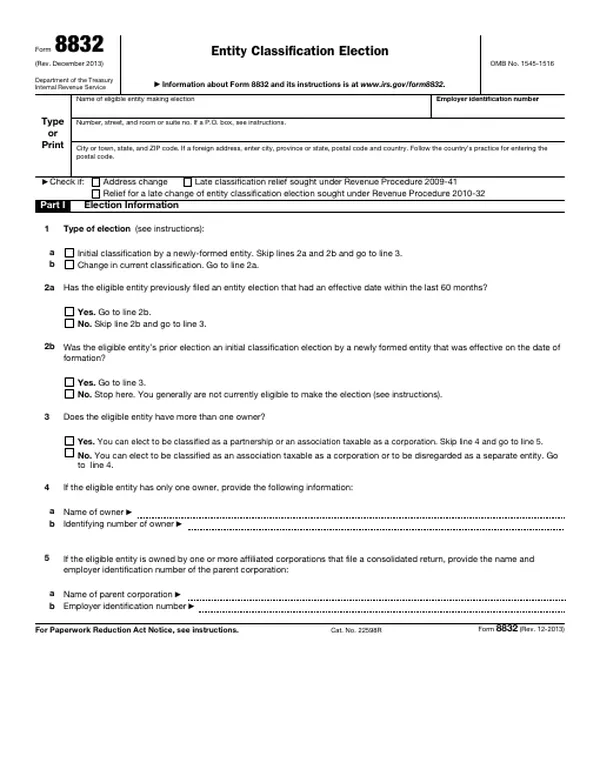
Line by line
- HeaderName, EIN, address; check boxes
- Name of the eligible entity, its EIN (required; IRM 3.13.2.27.4 says “An EIN will never be assigned from Form 8832”), address, and boxes for address change, late classification relief under Rev. Proc. 2009-41, and relief for a late change under Rev. Proc. 2010-32.
- 1Type of election
- 1a: initial classification by a newly formed entity (skip line 2). 1b: change in current classification.
- 2a, 2b60-month limitation
- Whether a prior election was effective within the last 60 months and, if so, whether it was an initial election by a newly formed entity effective on formation. A No on 2b generally means the entity cannot elect now.
- 3More than one owner?
- Yes: partnership or corporation. No: corporation or disregarded entity; go to line 4.
- 4a, 4bName and identifying number of owner
- For a single-owner entity. IRM 3.13.2.27.4 says a foreign owner without a U.S. number enters none on 4b.
- 5a, 5bParent corporation
- Only if the entity is owned by affiliated corporations filing a consolidated return.
- 6a to 6fType of entity
- Domestic or foreign; corporation, partnership or disregarded entity. The box drives the CP 277 paragraph.
- 7Foreign country of organization
- Foreign entities only.
- 8Election is to be effective beginning
- The effective date. If blank, the filing date. More than 75 days before filing defaults to 75 days before; more than 12 months after defaults to 12 months after.
- 9, 10Contact person and telephone
- Who the IRS may call.
- ConsentConsent Statement and Signature(s)
- Signed by each member who is an owner when the election is filed, or by an officer, manager or member authorized to make the election. For a retroactive date, former owners during the gap sign too. Do not sign the copy attached to the return.
- Part II, 11Late Election Relief
- The explanation of why the election was not timely, signed under penalties of perjury by an authorized representative and each affected person with personal knowledge, declaring the Rev. Proc. 2009-41 section 4.01 requirements are met.
IRM 3.13.2.27.4 adds a processing note that differs from Form 2553: “Digital signatures are now acceptable on Form 8832.”
Where and how to file
The current form PDF begins with a mailing address update that supersedes the addresses in the 2013 instructions:
| Entity located in | Send to |
|---|---|
| CT, DE, DC, GA, IL, IN, KY, ME, MD, MA, MI, NH, NJ, NY, NC, OH, PA, RI, SC, VT, VA, WV, WI | Department of the Treasury, Internal Revenue Service, Kansas City, MO 64999 |
| AL, AK, AZ, AR, CA, CO, FL, HI, ID, IA, KS, LA, MN, MS, MO, MT, NE, NV, NM, ND, OK, OR, SD, TN, TX, UT, WA, WY | Department of the Treasury, Internal Revenue Service, Ogden, UT 84201 |
| A foreign country or U.S. possession | Department of the Treasury, Internal Revenue Service, Ogden, UT 84201-0023 |
Also attach a copy to the entity's return for the year of the election, or to the owners' returns if the entity does not file. The instructions say failing to attach the copy “will not invalidate an otherwise valid election, but penalties may be assessed” against those required to attach it. If no notice arrives within 60 days, the instructions say to call 1-800-829-0115 or write to the service center by certified or registered mail.
- Confirm the entity is eligible (not a per se corporation) and is choosing something other than its default.
- Check line 2: has a classification change been effective in the last 60 months?
- Pick an effective date no earlier than 75 days before the mailing date and no later than 12 months after it.
- Get the required signatures, including former owners for a retroactive date.
- Mail with proof of mailing, attach a copy to the return for the election year, and calendar a 60-day follow-up.
What the IRS does with it
Entity checks completeness, eligibility and timeliness. Approval posts TC 076 and issues CP 277 with the paragraph for the box checked on line 6; a deemed election from Form 2553 posts TC 074; denial posts TC 078 and the form is returned with a letter explaining corrective action (IRM 3.13.2.27 and 3.13.2.27.9). Incomplete forms go back with Letter 3574C or 3575C asking for a response within 30 days (IRM 3.13.2.27.4).
The effective date can move backward, not forward. IRM 3.13.2.27.3: if the requested date is more than 75 days before the earliest IRS received date, the IRS makes the election effective 75 days before that date and tells the taxpayer about relief, and the IRM caution adds “The effective date will be 75 days prior to the earliest IRS received date.” Unlike Form 2553, the date is not moved to the next tax year. Timeliness uses the postmark date.
Late relief depends on the route. Rev. Proc. 2009-41 covers stand-alone elections filed within 3 years and 75 days of the requested date; IRM 3.13.2.27.6 says Rev. Proc. 2013-30 “cannot be used for stand-alone Forms 8832” and applies only to deemed elections made with Form 2553. Beyond those windows, a private letter ruling is required. See late entity classification election relief and Section 9100 relief.
The 60-month rule is enforced at intake: IRM 3.13.2.27 says once an election is approved the taxpayer generally cannot file another for 60 months, except that a newly formed entity can cancel its initial election by electing its default classification by the due date of its first return. A withdrawal or rescission must be received by the due date of the initial return (IRM 3.13.2.27.10).
Common mistakes
- Filing to elect the default classification. Not needed, and the IRS will say so.
- No EIN. The IRS will not assign one from Form 8832; get the EIN first.
- Effective date too far back. It defaults to 75 days before receipt unless relief is requested.
- Missing signatures of former owners for a retroactive effective date.
- Using Rev. Proc. 2013-30 for a stand-alone 8832. Use Rev. Proc. 2009-41 or a ruling.
- Changing again within 60 months without qualifying for an exception.
- Old mailing address from the 2013 instructions instead of the update at the front of the PDF.
Questions practitioners ask
How far back can a Form 8832 election be effective?
No more than 75 days before the filing date. An earlier requested date defaults to 75 days before filing unless late election relief applies (instructions; IRM 3.13.2.27.3).
Does an LLC electing S status need Form 8832?
Generally no. A timely Form 2553 from an eligible entity is a deemed classification election (IRM 3.13.2.27.1).
Can a single-member LLC elect to be a partnership?
No. IRM 3.13.2.27.1 says a single-member LLC can elect only corporate classification; otherwise it is disregarded.
What if the entity missed the 75-day window?
Rev. Proc. 2009-41 relief is available within 3 years and 75 days of the requested effective date if its requirements are met; otherwise a private letter ruling is needed.
How soon can the entity change classification again?
Generally not for 60 months after an approved election, under the line 2 limitation and IRM 3.13.2.27, with the newly formed entity exception.