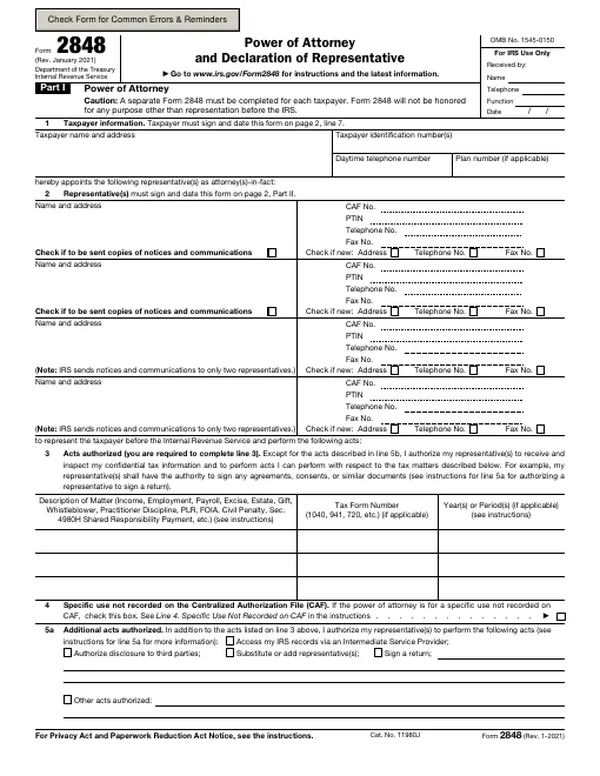
When to use Form 2848, and when another form is right
Use Form 2848 when the client wants someone to act for them: talk to the IRS, argue a position, sign agreements, consents and waivers, and receive notices. The instructions say the appointment covers inspecting and receiving confidential information and performing acts the taxpayer can perform, with listed exceptions. The person named must be eligible to practice before the IRS, which means one of the designations in Part II (a) through (r). See who can represent a taxpayer for the categories and their limits.
Use a different form when:
- The third party only needs to see information, not represent. That is Form 8821. The comparison is on Form 2848 vs Form 8821.
- The person acts as the taxpayer, not for the taxpayer: an executor, trustee, guardian or receiver. That is Form 56. The fiduciary then signs any Form 2848 on the taxpayer's behalf, and the CAF unit checks that the fiduciary is on the account first. IRM 21.3.7.5.1 tells examiners that when a fiduciary signs, they research the entity record to confirm the signer matches the second name line, and: “If the name does not match CC ENMOD or CC INOLES, reject the authorization and request Durable Power of Attorney, court appointment papers, guardianship papers or Form 56.” File the Form 56 (with the letters testamentary or court order) and let it post before the Form 2848 goes in. See Form 56 and fiduciaries.
- The authorization is for an individual client and the practitioner can use the online Tax Pro Account. The instructions note that most of those requests record immediately to the CAF.
- A BBA partnership needs a partnership representative. The instructions are explicit: “Form 2848 is not used to designate a partnership representative.” That designation is made on the return or on Form 8979; Form 2848 is how the PR appoints someone to act for it.
The address on a Form 2848 does not change the client's last known address. Use Form 8822 or 8822-B for that.
Line by line
- Line 1Taxpayer information
- Name, TIN, address, daytime phone, and plan number for an employee plan. One taxpayer per form. Spouses on a joint return each file their own Form 2848, even when they appoint the same person. A sole proprietor who wants representation for both personal and business matters enters both the SSN and the business EIN. For a BBA partnership, enter the partnership's name, address and TIN and show the PR's relationship, never the TIN of the PR or designated individual. For a consolidated return the instructions are unchanged: “Only the parent corporation information is required on line 1.” Do not attach a list of subsidiaries, list only Form 1120 on line 3, and have a subsidiary file its own Form 2848 for returns filed separately from the consolidated return (Forms 720, 940, 941). For a deceased individual's Form 1040, enter the decedent's name and SSN and the name, title and address of the executor or personal representative; for an estate, enter the decedent's name and the executor's name, title and address, with the decedent's SSN for Form 706 and the estate's EIN for other forms.
- Line 2Representative(s)
- Full name, mailing address, CAF number, PTIN, phone and fax for up to four people (attach another Form 2848 for more). If the representative has no CAF number, enter “None” and the IRS assigns one. Check the box under a name to send that person copies of notices; the IRS honors that box for no more than two representatives for the same matter. Use the identical full name on every filing so the CAF can match the record.
- Line 3Acts authorized
- Required. Three columns: description of matter (Income, Employment, Civil Penalty, Sec. 4980H, Centralized Partnership Audit Regime (BBA), and so on), tax form number, and years or periods. Ranges are allowed (“2018 thru 2020”); fiscal years use YYYYMM. The IRS will return any power of attorney with a general reference such as all years or all taxes. Future periods are allowed, but the IRS will not record on the CAF system future tax years or periods listed that exceed 3 years from December 31 of the year that the IRS receives the power of attorney. Penalties tied to a listed return are covered; a penalty not tied to a return (the trust fund recovery penalty against an individual, for example) needs its own “Civil Penalty” line. For innocent spouse matters, list Form 8857 here if the representative is to sign that form.
- Line 4Specific use not recorded on CAF
- Check only for one-off matters the CAF does not record: private letter rulings, EIN applications, Form 843 claims, accounting method changes, exemption applications, FOIA requests and the others listed in the instructions. A checked line 4 means the form is mailed or faxed to the office handling the matter, not to the CAF unit, and it does not revoke earlier authorizations recorded on the CAF.
- Line 5aAdditional acts authorized
- Boxes for access through an Intermediate Service Provider, authority to disclose to third parties, authority to substitute or add representatives, and signing a return, plus an “Other acts” line. None of these is included unless checked. Signing an income tax return is limited by Treas. Reg. 1.6012-1(a)(5) to disease or injury, continuous absence from the United States for at least 60 days before the due date, or IRS permission for other good cause, and the reason must be written on the line. Form 907 (extending the time to bring suit) also requires specific language here.
- Line 5bSpecific acts not authorized
- The printed text bars the representative from endorsing or negotiating a government check or directing a refund into an account the representative or the firm controls. Use the blank line to remove other acts, such as signing consents. The CAF unit codes any deletion here as a modified authorization.
- Line 6Retention/revocation of prior power(s) of attorney
- Leave it blank and the new form revokes earlier powers of attorney on file for the same matters and periods. Check it to keep them, and attach a copy of each one to keep. Filing Form 2848 does not revoke a Form 8821. A new PR of a BBA partnership who wants to keep a prior PR's appointee should not check this box and should file a new Form 2848 naming that person.
- Line 7Taxpayer declaration and signature
- Signature, date, printed name and title. Mail and fax filings need a handwritten signature; an electronic signature means online submission only. A corporate officer with authority to bind, any partner with authority under state law (attach proof), the PR or designated individual for a BBA partnership, one co-executor with authority, or a trustee signs for an entity. For a minor who cannot sign, a parent or court-appointed guardian signs.
- Part IIDeclaration of Representative
- Each representative enters the designation letter, the licensing jurisdiction and the bar, license or enrollment number, then signs and dates, in the same order as line 2. Attorneys and CPAs enter the state; enrolled agents enter the enrollment number; designations d to f enter the title or relationship; an unenrolled preparer (h) enters the PTIN; a student or law graduate (k) enters LITC or STCP and attaches the TAS authorization letter. If the taxpayer signs first, the representative must sign within 45 days (60 days for a taxpayer abroad).
Where and how to file
If line 4 is checked, send the form to the IRS office handling the matter. Otherwise the instructions give three routes:
| Route | Details from the instructions |
|---|---|
| Online | IRS.gov/Submit2848, after signing in with an ID.me verified identity. Required if any signature is electronic. The September 2021 instructions still refer to a Secure Access account; that sign-in has been retired, and the IRS account page now says you need “an account with ID.me to sign in” and lists Forms 2848 and 8821 among the services it covers. |
| Fax or mail, eastern states | AL, AR, CT, DE, DC, FL, GA, IL, IN, KY, LA, ME, MD, MA, MI, MS, NH, NJ, NY, NC, OH, PA, RI, SC, TN, VT, VA, WV: Internal Revenue Service, 5333 Getwell Road, Stop 8423, Memphis, TN 38118. Fax 855-214-7519. |
| Fax or mail, western states | AK, AZ, CA, CO, HI, ID, IA, KS, MN, MO, MT, NE, NV, NM, ND, OK, OR, SD, TX, UT, WA, WI, WY: Internal Revenue Service, 1973 Rulon White Blvd., MS 6737, Ogden, UT 84201. Fax 855-214-7522. |
| Outside the United States | APO/FPO, U.S. territories, foreign addresses: Internal Revenue Service, International CAF Team, 2970 Market Street, MS: 4-H14.123, Philadelphia, PA 19104. Fax 855-772-3156, or 304-707-9785 from outside the United States. |
Uploading an e-signed form carries an identity check. The instructions say that if the taxpayer e-signs in a remote transaction (the submitter is not physically present), the submitter “must attest that he or she has authenticated the taxpayer’s identity”, unless personal knowledge from a prior business, family or employment relationship already allows it. The online submission page puts it the same way: “You must authenticate a taxpayer’s identity when both of these apply”, no personal or business relationship with the taxpayer, and an electronic signature in a remote transaction. For an individual that means inspecting a government photo ID against a selfie or video call, recording the name, SSN or ITIN, address and date of birth, and verifying them against a second document such as a return, IRS notice or utility statement; for an entity, also confirming that the signer has authority to bind it. Keep the records. A new client who signs on a tablet in your office is not remote; a new client who signs a PDF at home is.
The instructions warn that the fax numbers may change without notice and point to the Recent Developments area of IRS.gov/Form2848. For individual clients, the Tax Pro Account route skips the fax queue entirely; IRM 21.3.7.1.7 describes it as an online system whose authorizations are automatically loaded to the CAF database. A CAF submission cover sheet helps when faxing several clients.
What the IRS does with it
The CAF function at the Memphis, Ogden and Philadelphia campuses works the form under IRM 21.3.7. Faxes arrive in the Enterprise File Storage platform and are processed by clerks and tax examiners. Timing is strictly by queue: “Receipts received in the CAF Functions are processed first in first out (FIFO), regardless of the method used to submit the authorization.” Faxes received before 2:00 p.m. local time count as received that day.
The examiner checks five essential elements (IRM 21.3.7.5.1):
- Taxpayer's dated signature. “An electronically signed, printed or stamped signature is not acceptable,” except for electronic signatures that came through the online platform. A hand printed signature is acceptable; for business accounts a title is also required.
- Representative's designation, jurisdiction, number, signature and date. This element applies only to Form 2848. The IRM tells examiners: “Do not reject solely for the missing bar or license number if the state abbreviation or Licensing jurisdiction (state) or other licensing authority information is provided.”
- Acts authorized, meaning type of tax or form number and specific periods.
- Clear identification of the taxpayer (name, address, TIN), validated against IDRS. A missing TIN is rejected to the taxpayer.
- Clear identification of the representative (name and address). A CAF number is not required.
The 45-day rule is also checked under element 1: when the taxpayer signs first, the signature dates must be within 45 days for domestic authorizations and within 60 days for authorizations of taxpayers residing abroad. When the dates are good, the form can be submitted at any time.
The examiner codes the record: modified or unmodified (anything on line 5b, or a line 5a act beyond disclosure, substitution or signing, is a modification), a “Y”, “D” or “S” for the three standard line 5a acts, and an “N” for each representative who gets notices. Line 4 forms are not loaded at all. If line 6 is blank, the record goes in with action code R and replaces earlier authorizations for the same matters. When the document dates conflict, the IRM gives authority to the form with the most recent taxpayer signature date.
If something is missing, the CAF unit sends Letter 861C. Missing elements 1, 3, 4 or 5 go to the taxpayer for domestic forms; a missing element 2 goes to the representative. When only one of several representatives is defective, the others are processed and marked “Processed” before the letter goes out (IRM 21.3.7.13.1).
What an unrecorded Form 2848 can and cannot do. While the form sits in the queue, a wet-signed copy still works on the phone. The Practitioner Priority Service chart in IRM 21.3.10.3.1.1 tells the assistor to help when the caller “has a Form 2848 processed to CAF database or the caller is submitting Form 2848 via fax”, and the assistor forwards a first-time fax to the CAF unit. For transcripts, IRM 21.2.3.5.3.2.2 says “A valid Form 8821 or Form 2848 submitted at the time of the call does not need to be first processed by the CAF unit” for the assistor to drop transcripts into the caller's e-Services mailbox. Self-service is different: under IRM 21.3.10.4.4, “If the practitioner is registered for e-services and a Form 2848 or Form 8821 is recorded on the CAF database, the caller may use TDS.” Until the record posts, the Transcript Delivery System and other e-Services lookups will not see the client. One more limit from the same PPS section: “Unprocessed authorization that was submitted through TDC with an electronic signature is not acceptable during phone verification.” If the client e-signed and the upload is pending, there is no form to fax, so plan for the wait or use Tax Pro Account.
Authorizations do not survive the client. IRM 21.3.7.10: “Authorizations expire with the death of the taxpayer and must be deleted from the CAF database after verification (death certificate or Form 56) is received.” After a death the executor files Form 56 and then signs a new Form 2848 for the decedent's and the estate's matters.
Common rejections and mistakes
IRM 21.3.7.13.1 lists the standard Letter 861C reasons. The ones practitioners see most:
- Old revision. “The CAF processing sites will not process Form 2848 with a revision date prior to October 2011.”
- Electronic signature by mail or fax. E-signed forms must go through IRS.gov/Submit2848.
- General references on line 3 (“all years”) or a missing form number or period.
- Taxpayer and representative dates more than 45 days apart when the taxpayer signed first.
- Missing title for a business signer, or no designation, jurisdiction or number in Part II.
- Line 6 checked without the prior authorization attached. The IRM tells examiners to check the CAF first; if nothing is recorded they process anyway.
- Sign-a-return box checked with no reason under Treas. Reg. 1.6012-1(a)(5).
- Business vs. individual mismatch. An officer (designation d) cannot represent an individual on Form 1040, and a full-time employee (e) can represent the individual only where research shows the business relationship, such as a sole proprietorship.
- Name mismatch. If the line 1 name does not match any name control on IDRS, the form is not processed.
- Executor or trustee signs with no fiduciary on record. The CAF unit compares the signer to the second name line on the entity record and rejects when there is no match, asking for court papers or Form 56 (IRM 21.3.7.5.1).
- Remote e-signature from a client the firm does not know, uploaded without the identity authentication the instructions require.
More detail, with fixes, is on why the CAF unit rejects a Form 2848. To end an authorization, see revoking and withdrawing authorizations. To find or recover a CAF number, see CAF number.
Questions practitioners ask
Do spouses who filed jointly need one Form 2848 or two?
Two. The instructions and IRM 21.3.7.5.3.1 require each spouse to file and sign a separate Form 2848, even if both appoint the same person. If only one spouse wants representation, only that spouse signs. Either spouse's representative can access information on the joint return.
Can I submit a Form 2848 that the client signed electronically by fax?
No. The instructions say a form with an electronic signature or a digitized image of a handwritten signature may only be submitted online at IRS.gov/Submit2848. The CAF unit returns e-signed forms that arrive by mail or fax.
Does a new Form 2848 cancel the old one?
Yes for the same matters and periods, unless line 6 is checked and a copy of the earlier form is attached. It does not revoke a Form 8821, and a line 4 specific-use form does not revoke anything recorded on the CAF.
How far into the future can line 3 go?
The CAF records future periods only up to 3 years after December 31 of the year the IRS receives the form. A filing received in 2026 can therefore be recorded through 2029. For BBA partnerships, future years are not allowed because the PR is designated on a filed return.
Does Form 2848 cover a penalty the IRS proposes?
If the penalty relates to a return listed on line 3, yes. A penalty not tied to a listed return, such as a trust fund recovery penalty against an individual for a company's payroll taxes, needs its own line describing the civil penalty and periods.
Can a representative add a colleague to the authorization?
Only if the taxpayer checked the substitute or add box on line 5a or gave written permission. Otherwise the client has to sign a new Form 2848 naming the colleague.
My client died. Who signs the Form 2848 and what does the CAF unit need first?
The executor or personal representative signs, and the CAF unit will only accept that signature if the fiduciary is already on the account. File Form 56 with the letters testamentary first; IRM 21.3.7.5.1 has examiners reject a fiduciary-signed authorization when the signer does not match the second name line and ask for court papers or Form 56. Any Form 2848 the client signed in life is deleted once the IRS verifies the death (IRM 21.3.7.10).
Can I call PPS or pull transcripts before the CAF unit records the form?
You can call. PPS assists with a wet-signed Form 2848 faxed during the call, and the assistor can deposit transcripts into your e-Services mailbox without waiting for the CAF unit (IRM 21.3.10.3.1.1, 21.2.3.5.3.2.2). You cannot use the Transcript Delivery System yourself until the authorization is recorded on the CAF (IRM 21.3.10.4.4), and an e-signed form pending in the online queue cannot be used for phone verification at all.