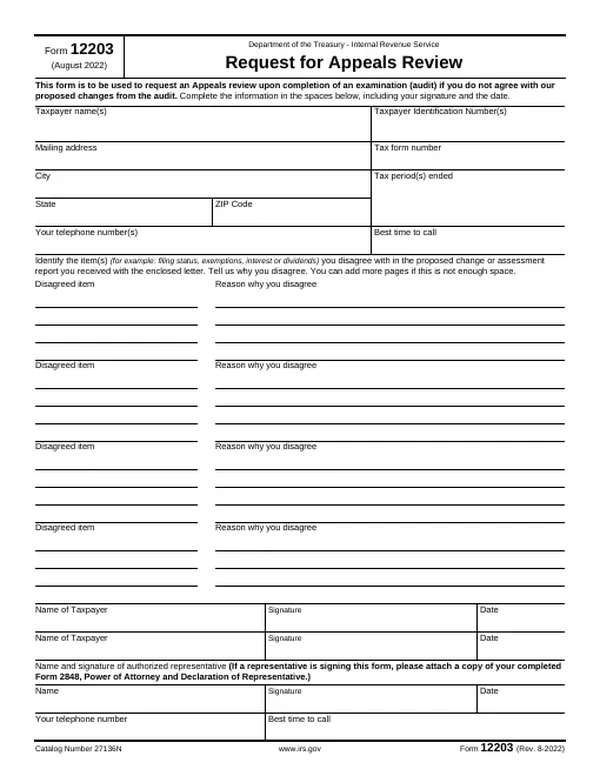
When to use Form 12203, and when a formal protest is required
The form states its purpose: use it to request Appeals review when the IRS proposes adjustments from an examination of $25,000 or less to a tax year examined. Publication 5 sets the full rule. A small case request is allowed if the total tax and penalties for each period in the letter is $25,000 or less, counting a proposed increase or decrease in tax including penalties, or a claimed refund. For an offer in compromise, the measure is total unpaid tax, penalty and interest per period. The taxpayer can either write a brief statement of the disputed issues and reasons, or use the appeal form that came with the letter, often Form 12203 or Form 13683.
A formal written protest is required instead when:
- Any period exceeds $25,000. Publication 5: “If more than one tax period is involved and any tax period exceeds the $25,000 threshold, you must file a formal written protest for all periods involved.”
- The case is an employee plan or exempt organization case, regardless of amount.
- The case is a partnership or S corporation case, regardless of amount.
Collection disputes (liens, levies, installment agreements) use their own procedures, not Form 12203. If the letter is a notice of deficiency rather than a 30-day letter, the route is a Tax Court petition within the 90 days, not this form. The general process is on the small case request and the Independent Office of Appeals. Before appealing, the form suggests talking to the examiner and the examiner's supervisor, and Publication 5 notes Fast Track Settlement for qualifying cases.
Line by line
- HeaderTaxpayer name(s), TIN(s), mailing address, phone, best time to call
- As on the exam letter. Both spouses for a joint return.
- HeaderTax form number and tax period(s) ended
- The return and each period in the letter, for example Form 1040, 12/31/2024.
- ItemsDisagreed item / Reason why you disagree
- Four pairs of lines, with more pages allowed. Name each item from the report (filing status, a deduction, interest income, a penalty) and say why the proposed change is wrong. Facts, documents and law go here; the form does not require the penalties of perjury statement or the detailed format of a formal protest. Appeals will consider the reasons except those based only on moral, religious, political, constitutional, conscientious objection or similar grounds.
- SignaturesName, signature and date of each taxpayer
- Both spouses sign for a joint return.
- RepresentativeName, signature, phone, best time to call
- If a representative signs, attach Form 2848. The form says the representative must be an attorney, CPA or enrolled agent authorized to practice before the IRS.
Where and how to file
Return the form in the envelope provided to the address in the heading of the IRS letter, within the time limit in the letter. Publication 5: “Send your protest to the IRS address in the letter you received within the time limit specified in the letter.” The exam function, not Appeals, receives it and forwards the case.
Check the statute first. Publication 5 says IRS policy for the originating function may require more than 365 days to remain on the assessment statute when the case reaches Appeals, and the IRS will ask for an extension if needed. If the taxpayer will not extend, Appeals will not accept the case and the IRS issues the statutory notice instead. See Form 872 statute extensions and the 365-day rule.
If no request is filed and the case involves income tax, the form says the IRS will send a notice of deficiency and a bill, and the Tax Court route remains.
What the IRS does with it
When the case arrives, IRM 8.6.1.2 has the Appeals officer verify the statute and send an acknowledgment and conference letter (Letter 5157 for non-docketed cases) within 45 days for liability and penalty cases. Conferences are informal; “Generally, conferences are held by phone”, though video, virtual and in-person options exist (IRM 8.6.1.5.1). For specified taxpayers with a scheduled conference, IRC 7803(e)(7) gives access to the nonprivileged case file at least 10 calendar days prior to their conference (IRM 8.6.1.2.1).
Appeals reviews only the disputed points. IRM 8.6.1.7.2: “Appeals will not raise new issues and will focus dispute resolution efforts on resolving the points of disagreement identified by the parties. The Appeals process is not a continuation or an extension of the examination process.” It settles on the hazards of litigation.
New evidence can send the case back. Under IRM 8.6.1.7.5, if the taxpayer provides information not shared with the examiner that needs investigation or substantial analysis, and at least 210 days will remain on the statute when exam gets it, Appeals can release jurisdiction to exam for review. Getting all documents to the examiner before requesting Appeals avoids that loop. If no agreement is reached, the form says Appeals issues the notice of deficiency, and the taxpayer can petition the Tax Court before paying, or pay and sue for a refund.
Common rejections and mistakes
- Using Form 12203 when one period exceeds $25,000. All periods then need a formal protest.
- Using it for a partnership or S corporation exam.
- Listing items without reasons. The disagreed item and the reason are both needed.
- Missing the response date in the 30-day letter, which leads to the statutory notice.
- Representative signs without Form 2848 attached.
- Holding back documents for Appeals. New information can be returned to exam.
- Refusing a needed statute extension, which keeps the case out of Appeals.
- Treating Form 12203 as a petition. It is an administrative request. If a notice of deficiency has already been issued, the route is the Tax Court petition within the time stated in the notice, not this form.
For a correspondence exam, the letter proposing the changes is usually a Letter 525; for a field or office exam it is usually a Letter 950 with the revenue agent's report. Both state the response date. The broader exam path is on correspondence examinations and the revenue agent's report.
Questions practitioners ask
What counts toward the $25,000 limit?
Publication 5 counts the proposed increase or decrease in tax, including penalties, or the claimed refund, for each tax period in the letter. If any one period is over $25,000, a formal protest is required for all periods.
Can an S corporation use Form 12203?
No. Publication 5 requires a formal written protest in partnership and S corporation cases regardless of the dollar amount, and in employee plan and exempt organization cases.
Where do I send Form 12203?
To the address in the heading of the IRS letter that proposed the changes, usually in the envelope provided. Do not send it to Appeals directly.
Is a penalties of perjury statement required on a small case request?
Publication 5 lists that statement among the requirements for a formal written protest. Form 12203 itself has only signature lines; a brief written statement listing the issues and reasons is the alternative Publication 5 allows.
Will Appeals raise new issues in a small case?
No. IRM 8.6.1.7.2 says Appeals will not raise new issues and will focus on the points of disagreement identified by the parties.
What happens if the case does not settle in Appeals?
The form says Appeals will send a notice of deficiency for income tax cases, after which the taxpayer can petition the Tax Court before paying, or pay and file a refund suit.