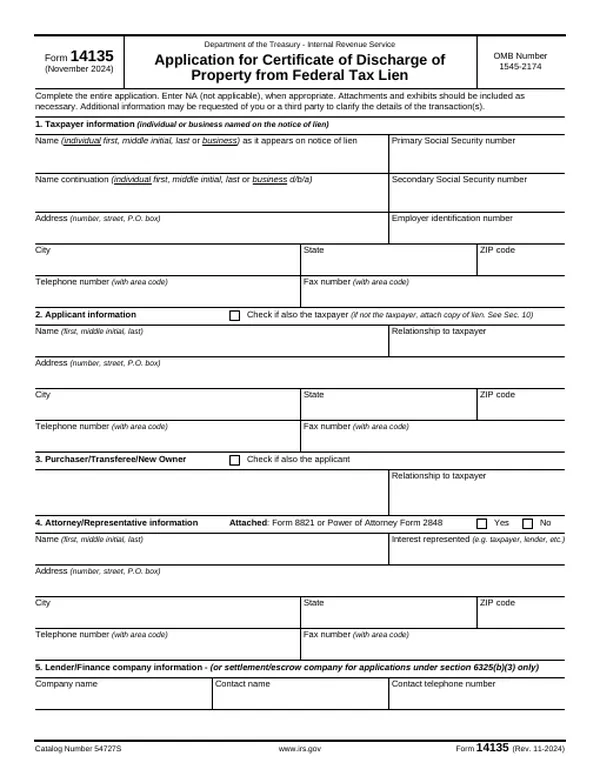
When to use Form 14135 (and when another certificate fits)
IRM 5.12.10.3: “A discharge is the process of removing a specific piece of property from the federal tax lien.” It is the tool for selling or transferring a particular asset while the lien remains on everything else. After a discharge, the IRM notes, the lien continues in full force on all other property. A refinance usually calls for subordination instead, and a lien filed against the wrong person calls for a certificate of non-attachment; to remove the notice from the public record entirely, see Form 12277. For the overall picture, see federal tax liens.
The application must fit one of the statutory grounds. IRM 5.12.10.3 states an agreement that does not ensure one of the IRC 6325(b) conditions is met “would exceed the IRS' discharge authority under section 6325(b).”
| Ground | Condition (IRM 5.12.10.3) | Certificate |
|---|---|---|
| 6325(b)(1) | Remaining property is worth at least double the lien plus senior encumbrances | Form 669-A |
| 6325(b)(2)(A) | The IRS is paid at least the value of its interest; the taxpayer is divested | Letter 403 and Form 669-B |
| 6325(b)(2)(B) | The government's interest has no value; the taxpayer is divested | Letter 402 and Form 669-C |
| 6325(b)(3) | Sale proceeds held in escrow subject to the IRS's claims | Form 669-H |
| 6325(b)(4) | A third-party owner deposits the value of the IRS's interest or posts a bond | Form 669-G |
Section by section
The form says to complete the entire application, enter NA where appropriate, and expect requests for more information from the applicant or third parties.
- 1Taxpayer information
- The individual or business named on the notice of lien, with SSNs or EIN, address and phone.
- 2Applicant information
- Check if also the taxpayer; otherwise attach a copy of the lien (see section 10). Name, relationship to the taxpayer and contact details.
- 3Purchaser/Transferee/New Owner
- The buyer, with relationship to the taxpayer.
- 4Attorney/Representative information
- Whether a Form 8821 or Form 2848 is attached, and the interest represented (taxpayer, lender and so on).
- 5Lender/Finance company information
- Or the settlement or escrow company for a 6325(b)(3) application.
- 6Monetary information
- Proposed sales price and the expected proceeds to be paid to the United States (0.00 if none).
- 7Basis for discharge
- Check the IRC 6325(b) ground. A non-taxpayer owner applying under (b)(2)(A) also completes section 16; (b)(4) is only for an owner who is not the taxpayer.
- 8Description of property
- What and where it is. A legible deed or title with the legal description is required for real estate; (b)(1) applications also need deeds for the property remaining under the lien.
- 9Appraisal and valuations
- A professional appraisal by a disinterested third party, plus one more valuation (county assessment, informal third-party valuation, auction price or other). (b)(1) applications need valuations for the remaining property too.
- 10Copy of federal tax lien(s)
- Required if the applicant is not the taxpayer, or list the serial numbers.
- 11Sales contract/purchase agreement
- Or describe how and when the taxpayer will be divested.
- 12Current title report
- Or list senior encumbrances with holder, type, date, original amount and rate, payoff and any family relationship.
- 13Proposed closing statement (aka HUD-1)
- Or itemize all proposed costs, commissions and expenses of sale.
- 14Additional information
- Pending litigation or unusual circumstances.
- 15Escrow agreement
- For (b)(3): type of account, depositary, payment conditions, cost and signatures of all parties including the Advisory Group Manager.
- 16Waiver
- For a non-taxpayer owner under (b)(2): waive the (b)(4) deposit treatment and the IRC 7426(a)(4) suit, or the application is treated as a (b)(4) deposit.
- 17Declaration
- Signed under penalties of perjury, with title for a business.
Where and how to file
Pub 783 (Rev. 12-2022) says to mail the completed Form 14135 and attachments to IRS Advisory Consolidated Receipts, 7940 Kentucky Drive, Stop 2850F, Florence, KY 41042, and refers to Publication 4235 for Advisory contacts. Its timing advice: “Please submit your application at least 45 days before the transaction date that the certificate of discharge is needed.” Pub 783 is older than the November 2024 form, so confirm the current address on IRS.gov before sending.
- Get a payoff of all liens (Pub 783 gives 1-800-913-6050 or the assigned revenue officer) and a title report.
- Order a disinterested professional appraisal and a second valuation.
- Assemble the contract, draft closing statement with all costs, deed and lien copies.
- Choose the IRC 6325(b) ground; for a third-party owner, decide on the section 16 waiver.
- File at least 45 days before closing and do not send payment with the application.
Payment rules from Pub 783: discharges under (b)(1) and (b)(2)(B) require no payment; (b)(2)(A) requires payment, but the Advisory Group Manager tells you the amount and when to pay; (b)(3) requires an approved escrow agreement first; (b)(4) requires a bond or deposit in an amount Advisory determines. Payments are made by certified, cashier's or treasurer's check, money order or cash; a personal check delays the certificate until it clears.
What the IRS does with it
Advisory works lien certificates (IRM 5.12.10.2). Pub 783 says Advisory staff will review and verify the information, may contact the applicant, representative or anyone involved in the transaction, and the Advisory Group Manager approves the determination; if approved, the applicant receives a conditional commitment letter, and in a foreclosure the letter comes within 30 days of a complete, approved application.
Valuation drives the (b)(2)(A) amount. IRM 5.12.10.3.2 allows reasonable and necessary expenses of sale, and lets Advisory use forced sale value rather than fair market value when market conditions support it, noting “it is Advisory's decision if it will be used.” It also states that the government's interest will not be reduced to pay an interest junior to the federal tax lien.
Short sales are a no-value case. IRM 5.12.10.3.3.1 says short sale applications are considered under (b)(2)(B) and, because the senior lien takes all the equity, the government's interest is generally valueless; the IRS cannot require payment of amounts the senior lender chooses to release to cover expenses.
For (b)(1), IRM 5.12.10.3.1 shows the doubling math (in its example, a $10,000 lien plus $51,000 of senior claims requires $122,000 of remaining property) and says the application is not considered unless the taxpayer is in filing compliance, current on deposits or estimated payments, and has addressed the balance due.
A third-party owner who pays under (b)(2)(A) gives up the refund suit that (b)(4) preserves. Section 16 and IRM 5.12.10.3.2 say that without a written waiver, the IRS treats the owner's application as a (b)(4) deposit.
Common problems
- Filing too close to closing. Pub 783 asks for 45 days.
- No independent appraisal or only one valuation.
- Closing statement with junior creditors paid ahead of the IRS. The government's interest is not reduced for junior claims.
- Taxpayer not divested in a (b)(2) or (b)(3) application.
- Payment sent with the application. Wait for Advisory's figure.
- Third-party owner skips section 16 without understanding the deposit treatment.
Questions practitioners ask
How long does a discharge take?
Pub 783 asks applicants to file at least 45 days before the transaction date. In a foreclosure, it says the conditional commitment letter comes within 30 days of a complete, approved application.
Does the IRS take all the sale proceeds?
Under (b)(2)(A) the IRS is paid the value of its interest after senior liens and allowable selling expenses, as Advisory determines. Under (b)(2)(B), such as most short sales, no payment is required.
Is discharge the right tool for a refinance?
Usually not. IRM 5.12.10.2 says subordination is generally used for refinancing, and discharge for selling or transferring a specific property.
Can the buyer or a co-owner apply?
Yes. Section 2 covers an applicant who is not the taxpayer (attach the lien), and section 16 explains the waiver choice for a non-taxpayer owner applying under (b)(2).
When is payment made?
Not with the application. Pub 783 says the Advisory Group Manager will tell the applicant the amount and when to pay under (b)(2)(A), and that (b)(3) and (b)(4) have their own escrow and deposit steps.