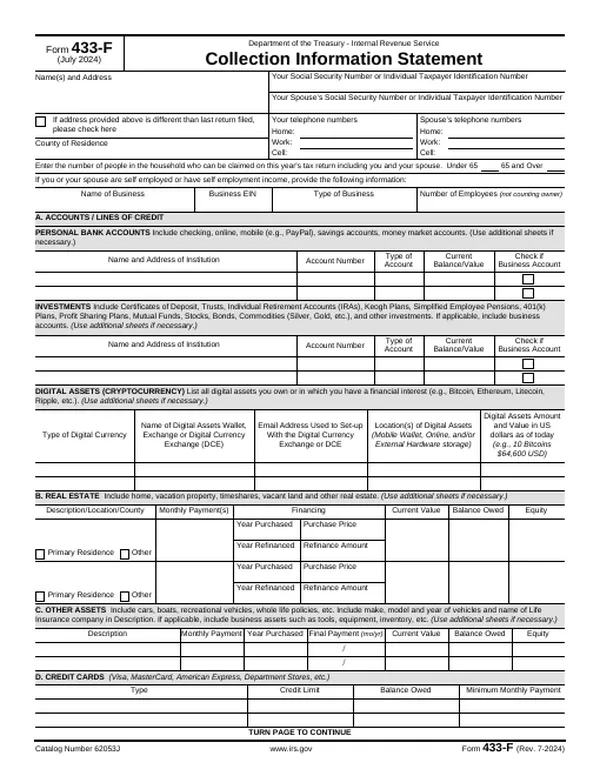
When Form 433-F is the right form
IRM 5.15.1.2 lists the three collection information statements and describes Form 433-F as the one “Used by the Automated Collection System (ACS) and the campuses for individuals.” If a client's balance is in ACS and the IRS asks for financial information before setting up a non-streamlined installment agreement or reporting the account currently not collectible, this is the form it wants.
Revenue officers can also accept it in two situations named in the same paragraph: for trust fund recovery penalty investigations when the individual is a wage earner and the potential TFRP is less than $100,000, and for self-employed and wage-earner individuals who owe IMF liabilities only with an aggregate assessed balance under $250,000. Above those lines, or where the revenue officer wants more detail, use Form 433-A.
It is never the right form for an offer. IRM 5.15.1.2 is explicit: “Form 433-F cannot be used for Offer-in-Compromise cases or for cases designated as Abusive Tax Avoidance Transactions (ATAT).” An offer needs Form 433-A (OIC) from the Form 656-B booklet. And many payment plans need no statement at all: IRM 5.14.1.4 says financial statements are not required for Simple Payment Plans and Guaranteed Installment Agreements.
Section by section
The form is two pages with instructions on the following pages. The instructions say to use a separate sheet when a section is too small and to keep a copy of the completed form and the supporting documents.
- HeaderName(s), address and identification
- Names, address, SSN or ITIN for the taxpayer and spouse, phone numbers, county of residence, a box to check if the address differs from the last return, and the number of household members under 65 and 65 or over who can be claimed on this year's return. Self-employed filers also enter the business name, EIN, type and number of employees.
- AAccounts / Lines of Credit
- Personal bank accounts including online and mobile accounts such as PayPal, investments (CDs, trusts, IRAs, 401(k)s, stocks, bonds, commodities), and digital assets with the wallet or exchange used, the email used to set it up, where the assets are held and their current dollar value. The instructions say to list all accounts even with no balance, include business accounts where applicable, and not to list bank loans here.
- BReal Estate
- Each property with location, monthly payment, purchase and refinance years and amounts, current value, balance owed and equity, marked as primary residence or other.
- COther Assets
- Vehicles, boats, RVs, whole life policies and, where applicable, business tools, equipment and inventory, with monthly payment, final payment date, value, balance and equity.
- DCredit Cards
- Each card's type, credit limit, balance owed and minimum monthly payment.
- EBusiness Information
- E1: accounts receivable owed to the taxpayer or the business, including government grants and contracts, with the total available to pay the IRS now. E2: merchant accounts if the business accepts card payments or digital assets.
- FEmployment Information
- Employer, pay frequency, gross pay and taxes withheld per period, and time with the employer, for the taxpayer and spouse. A current pay stub can be attached instead.
- GNon-Wage Household Income
- Monthly alimony, child support, net self-employment income, net rental income, unemployment, pension, interest and dividends, Social Security and other income. Attach a current-year profit and loss statement for self-employment or rental income; enter zero for a net loss and do not deduct depreciation.
- HMonthly Necessary Living Expenses
- Five groups, each with an actual monthly column and an IRS allowed column that the IRS completes: food and personal care (national standards), transportation, housing and utilities, medical (health insurance and out-of-pocket costs), and other (child care, estimated tax payments, term life insurance, required retirement contributions, union dues, delinquent state and local taxes, student loans, court-ordered payments).
- SignSignature
- Signed under penalty of perjury by the taxpayer and spouse, with the date.
Section H's food and personal care block has a shortcut: the form says that if you do not spend more than the standard allowable amount for your family size, fill in the total only. The IRS will apply the national standard in the allowed column regardless; see Collection Financial Standards.
Where and how to submit it
There is no general mailing address. Send it to the unit that requested it, using the fax number or address in the IRS letter or the one the ACS employee gives on the call, or hand it to the revenue officer. The instructions say that a taxpayer requesting an installment agreement “should submit Form 9465, Installment Agreement Request, along with Form 433-F,” and that a large down payment may streamline the process. See Form 9465.
- Confirm the account is in ACS or at a campus, or that the revenue officer will accept a 433-F under the IRM 5.15.1.2 thresholds.
- Gather recent bank statements, pay stubs, a current profit and loss statement for any business or rental activity, and statements for loans and recurring bills.
- Complete Sections A through H, writing N/A where something does not apply, and attach extra sheets as needed.
- Sign (both spouses for a joint liability) and send it, with Form 9465 if an installment agreement is being requested.
- Calendar a follow-up: the instructions warn the IRS may ask for supporting documentation after review.
What the IRS does with it
The analysis is the same as for any CIS. IRM 5.15.1.3 tells the employee to compute disposable income (gross income less allowable expenses), to look for liquid assets and equity first, and to request full or partial payment from assets before installment terms. The employee completes the IRS allowed column in Section H by applying the standards; expenses above the standards need support, because “The taxpayer must provide reasonable substantiation of all expenses claimed that exceed the standard amount” (IRM 5.15.1.2).
The result points to an installment agreement amount, a partial payment agreement, a currently not collectible closing, or a request that an asset be sold or borrowed against. IRM 5.15.1.2 also tells the employee to explain how the amount was calculated, and digital assets reported in Section A are a specific focus under IRM 5.15.1.26.1.
Accounts in ACS can move quickly toward levy. If the client has received a final notice of intent to levy, keep the CDP deadline in view while the 433-F is being prepared; a financial statement does not by itself stop the 30-day clock.
Common mistakes
- Using 433-F for an offer. It will not be accepted; use Form 433-A (OIC).
- Leaving out zero-balance accounts. The instructions say to list all accounts even if they have no balance.
- Listing bank loans in Section A. The instructions say not to.
- Negative self-employment or rental income. Enter zero for a loss and do not deduct depreciation; only cash expenses count.
- Filling in the IRS allowed column. That column is for the IRS; enter actual amounts.
- No profit and loss statement attached when Section G reports self-employment or rental income.
Questions practitioners ask
Will a revenue officer accept Form 433-F?
Sometimes. IRM 5.15.1.2 allows it for wage-earner TFRP investigations under $100,000 and for individuals who owe only IMF liabilities with an aggregate assessed balance under $250,000. Otherwise expect a request for Form 433-A.
Can Form 433-F support an offer in compromise?
No. IRM 5.15.1.2 says Form 433-F cannot be used for offer cases. Use Form 433-A (OIC) in the Form 656-B booklet.
Do I need Form 433-F for a streamlined installment agreement?
Often not. IRM 5.14.1.4 says financial statements are not required when the taxpayer qualifies for a Simple Payment Plan or a Guaranteed Installment Agreement.
Who fills in the IRS allowed column?
The IRS. Enter actual monthly expenses; the employee applies the Collection Financial Standards in the allowed column.
Should I send Form 9465 with Form 433-F?
If the goal is an installment agreement, yes. The Form 433-F instructions say a taxpayer requesting an installment agreement should submit Form 9465 along with Form 433-F.