When Form 8979 can be filed
The PR matters because, as IRM 4.31.9.7.6 puts it, “the PR has the sole authority to act on behalf of the partnership” under the BBA subchapter, and “All partners and the partnership are bound by the PR's actions.” The initial designation is made on the partnership's return; Form 8979 is for changes. See the partnership representative and designated individual.
The instructions limit when the form can be used. The partnership may submit it:
- Directly to the current IRS point of contact after Letter 2205-D (selection for exam) or Letter 5893 or 5893-A (notice of administrative proceeding).
- With an AAR filed for a reason other than only making a designation, before those letters issue (see Form 8082).
- With a Form 8985 submitted by a pass-through partnership that has not elected out of BBA.
- With Form 8988.
- When a BBA partnership makes a request of the IRS that requires extending a statute, such as certain private letter ruling requests.
A PR or DI resigning may submit the form only to the IRS point of contact after Letter 2205-D, 5893 or 5893-A. And an AAR cannot be filed just to change the PR; IRM 4.31.9.7.6 says “The partnership cannot file the AAR for the sole purpose of changing the designation or appointment.”
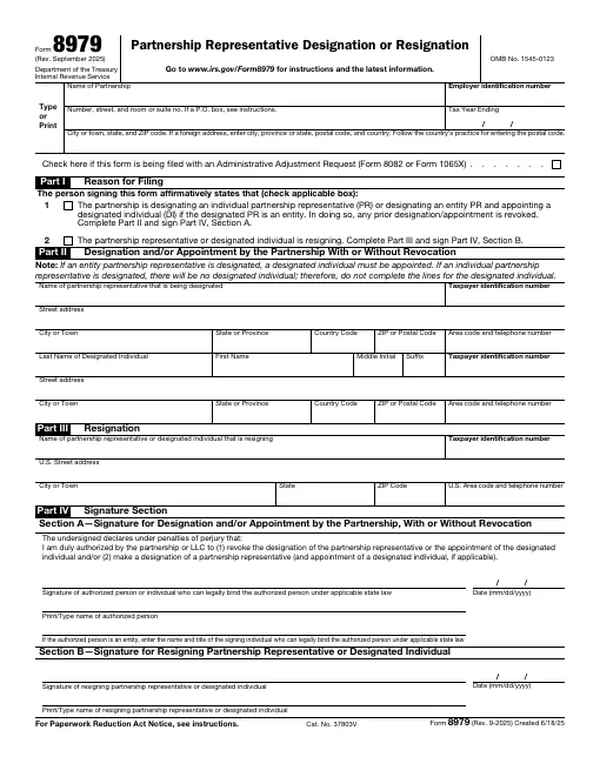
Part by part
- HeaderPartnership name, address, EIN and tax year ending
- One tax year per form; IRM 4.31.9.7.6.2 says a partnership changing the PR for several years submits a Form 8979 for each. Check the box above Part I if filing with an AAR (Form 8082 or Form 1065-X).
- Part I, 1Designation by the partnership
- The partnership is designating an individual PR, or an entity PR with a DI, which revokes any prior designation. Complete Part II and sign Part IV, Section A.
- Part I, 2Resignation
- The PR or DI is resigning. Complete Part III and sign Part IV, Section B.
- Part IIDesignation and/or Appointment by the Partnership With or Without Revocation
- The PR's name, U.S. mailing address, TIN and U.S. phone. If the PR is an entity, the DI's name, address, TIN and phone too; an entity PR without a DI is an invalid designation and the current PR stays in place.
- Part IIIResignation
- The resigning PR's or DI's name, U.S. street address, TIN and phone.
- Part IV, ASignature for Designation and/or Appointment by the Partnership
- Signed by an authorized person, defined in the instructions as someone who was a partner at any time during the tax year. If the authorized person is an entity, the individual who can legally bind it under state law signs and gives name and title.
- Part IV, BSignature for Resigning Partnership Representative or Designated Individual
- Signed by the resigning PR or DI, with name and capacity. An entity PR resigns through its DI's signature.
Both the PR and any DI must have substantial presence in the United States. The instructions and IRM 4.31.9.7.6.1 list three tests: availability to meet in person with the IRS in the United States at a reasonable time and place, a U.S. TIN, and a U.S. street address and a phone number with a U.S. area code.
Where and how to file
Outside an AAR, the instructions say to “mail or fax Form 8979 to the attention of the current IRS employee point of contact” (the revenue agent, Appeals officer or Counsel). With an AAR, follow the AAR filing instructions. IRM 4.31.9.7.6.4 adds that faxed forms need an original (not digital) signature, while forms received by email or taxpayer digital communication may carry a digital signature.
- Confirm a filing trigger exists: an exam letter or NAP, an AAR with another purpose, a Form 8985 or Form 8988 filing, or a statute-extension request.
- Confirm the new PR (and DI) meets the substantial presence test.
- Complete one form per tax year, with Part II fully completed for an entity PR and DI.
- Have an authorized person sign Part IV, Section A, with name and title.
- If a new PR wants a representative, file a new Form 2848; the instructions say this is required even if the same person was appointed by a prior PR.
- Send it to the IRS point of contact (or attach it to the AAR) and watch for the IRS letters confirming or rejecting it.
What the IRS does with it
The examiner date stamps the form, validates it on Form 15416, and within 30 days issues the letters that inform the partnership, the old PR and the new PR of the result. IRM 4.31.9.7.6.4 notes that “Form 8979 is deemed valid until the IRS says it's invalid.” Any valid actions of the former PR before the change remain in effect (IRM 4.31.9.7.6).
Repeated changes have a consequence. Under IRM 4.31.9.7.6.3, if the IRS receives multiple designations within a 90-day period that hurt the efficiency of the audit, it may determine that the last one results in no PR designation in effect and designate the PR itself. Once the IRS selects a PR, the partnership cannot revoke it without IRS permission, although the IRM notes permission cannot be unreasonably withheld.
A resignation leaves no PR in place. The instructions say the IRS will then ask the partnership to designate one, and if none is made within 30 days of the request, the IRS will make the designation.
The IRS is not bound by limits the partnership agreement puts on the PR. IRM 4.31.9.7.6 says the IRS is not bound by limitations, restrictions or agreements to which it is not a party, so internal governance of the PR has to be handled among the partners.
Common mistakes
- Filing outside a trigger, such as a stand-alone change with no exam, AAR or other filing.
- Entity PR with no DI. The designation is invalid.
- Signer is not an authorized person, meaning not a partner during the year in question.
- One form for several years. Each tax year needs its own Form 8979.
- Foreign PR or DI without a U.S. address, U.S. phone and U.S. TIN.
- Assuming the old POA carries over. A new PR must file its own Form 2848.
Questions practitioners ask
Can a partnership change its PR at any time?
No. The instructions limit filing to specific situations: after an exam letter or NAP, with an AAR filed for another reason, with Form 8985 or 8988, or with a request that requires a statute extension.
Who signs a designation?
An authorized person, meaning someone who was a partner at any time during the tax year. If that person is an entity, the individual who can legally bind it signs with name and title.
Can the PR be a non-partner or an entity?
Yes. IRM 4.31.9.7.6 says a PR can be any person, including the partnership itself, and need not be a partner. An entity PR must have a DI, and both need substantial presence in the U.S.
What happens when the PR resigns?
There is no PR in effect. The IRS asks the partnership to designate one and, if none is made within 30 days, designates one itself.
Does a new PR need a new Form 2848 for the firm handling the exam?
Yes. The instructions say a new PR that wants a person to represent it must submit a Form 2848, even if that person was appointed by a prior PR for the same year.